Generated with AI3 min read
Milling Machine
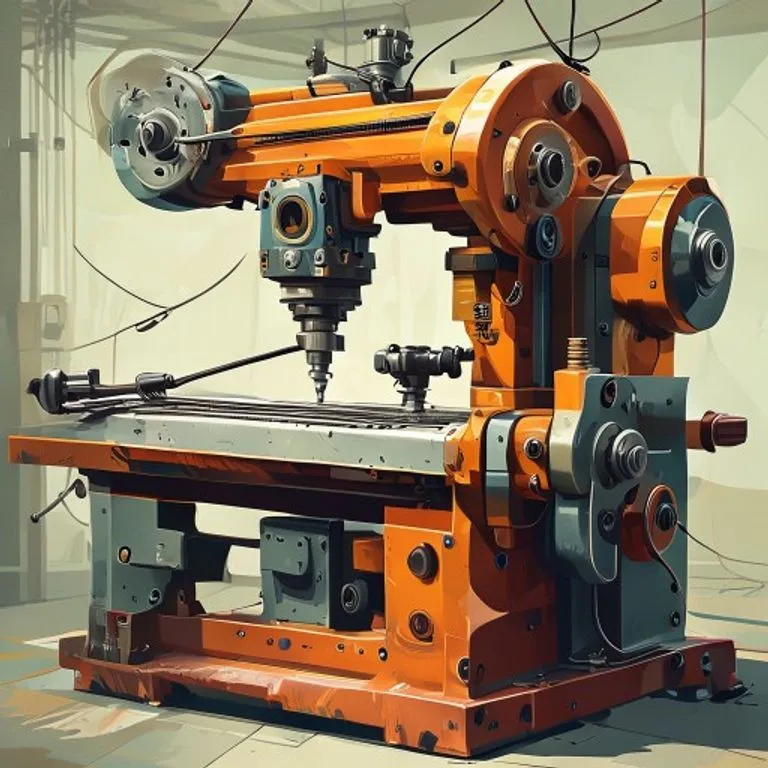
Brief description
A milling machine is a versatile machine tool that uses a rotating multi-tooth cutter, known as a Milling Cutter, to remove material from a workpiece. Unlike a lathe, where the workpiece rotates, in a milling machine, the cutter rotates while the workpiece is moved against it.
Use / Function
- Primary Use: Machining flat surfaces, slots, pockets, and complex shapes in metal, wood, or plastic.
- Secondary Uses: Drilling, boring, and gear cutting (with an indexing head).
- Scale: Industrial/Workshop. Essential for creating other machines.
Operating principle
The milling machine operates on the principle of rotary cutting. A spindle rotates a cutting tool (end mill, face mill) at high speed. The workpiece is clamped to a table that can move along three axes (X, Y, and Z). By feeding the workpiece into the rotating cutter, material is sheared away in the form of chips.
How to create it
Minimum functional version (Horizontal Mill)
- Frame: A heavy, rigid structure (cast iron or heavy steel) to dampen vibrations.
- Spindle: A horizontal shaft driven by a motor (or water/steam power) to hold the cutter.
- Table: A flat surface with T-slots to clamp the work, mounted on slides to move horizontally and vertically.
- Feed Mechanism: Handwheels connected to lead screws to move the table precisely.
Intermediate version (Vertical Mill)
- Vertical Spindle: The spindle is mounted vertically, allowing the use of end mills for plunging and pocketing.
- Quill: The spindle can be moved up and down (Z-axis) for drilling operations.
- Knee: The entire table assembly moves up and down the column for major Z-axis adjustments.
Materials needed
- Essential:
- Cast Iron: For the base, column, and table (provides mass and damping).
- Steel: For the spindle, lead screws, and cutting tools (Milling Cutters).
- Bronze: For bearings and lead screw nuts (sacrificial wear parts).
- Tools: Lathe (to make the spindle and screws), Drill Press, Scraper (for flattening ways).
Variants and improvements
- Horizontal Mill: Better for heavy material removal and gang milling.
- Vertical Mill: More versatile for die sinking and detailed work.
- Universal Mill: The table can swivel, allowing for spiral cutting (e.g., helical gears).
- CNC Mill: Computer-controlled for automated, complex machining.
Relationship with Lathes and Drills
The Milling Machine, the Lathe, and the Drill Press are complementary.
- While the lathe rotates the workpiece, the milling machine rotates the tool.
- The milling machine can perform many drilling operations, but the drill press is faster and more efficient for simple holes.
- The cutters used in the milling machine can be sharpened or partially manufactured on a lathe.
Limits and risks
- Safety: The rotating cutter is dangerous. Chips are hot and sharp. Eye protection is mandatory. Loose clothing or hair can be caught.
- Backlash: Lead screws have play; climb milling can be dangerous on manual machines without backlash eliminators.
- Vibration: Lack of rigidity causes “chatter,” ruining the surface finish and breaking tools.
- Complexity: Setup often takes longer than the actual machining. Requires precise alignment of all axes (tramming) to cut square.