Generated with AI3 min read
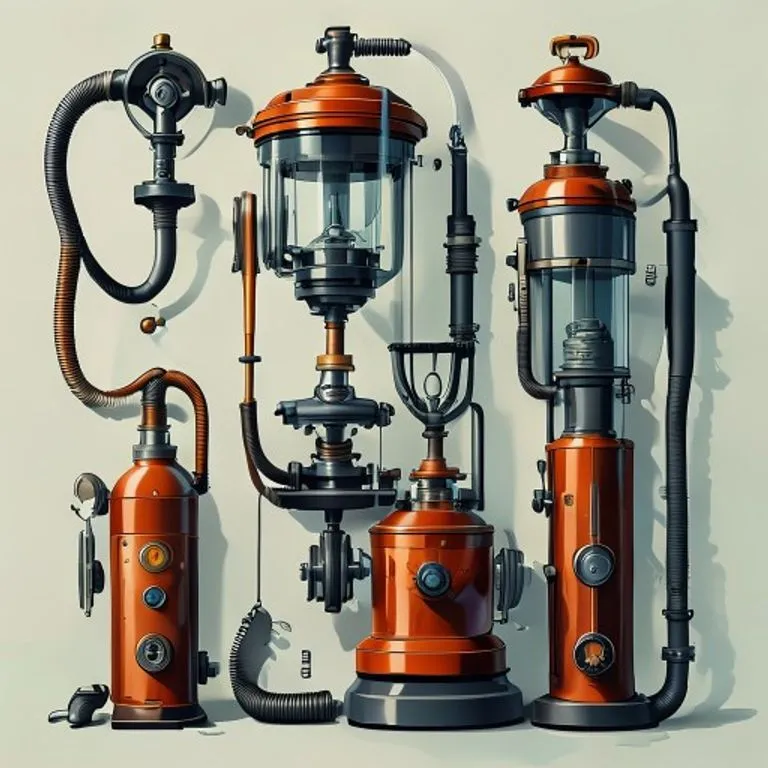
Vacuum Pump
Brief description
A vacuum pump is a device that removes gas molecules from a sealed volume in order to leave behind a partial vacuum. It was essential for early scientific discoveries regarding air pressure and is critical for creating light bulbs and vacuum tubes.
Use / Function
- Scientific Research: Demonstrating the effects of atmospheric pressure and the properties of a vacuum.
- Manufacturing: Evacuating Incandescent Light Bulb and Vacuum Tube.
- Chemistry: Lowering the boiling point of liquids for low-temperature distillation.
- Food Preservation: Early experiments in vacuum-sealing.
Operating principle
Most early vacuum pumps (like the Sprengel pump or reciprocating pumps) operate on the principle of displacement:
- Expansion: A chamber’s volume is increased (using a piston or falling liquid), which lowers the pressure inside.
- Suction: The low pressure draws gas out of the sealed vessel being evacuated.
- Isolation: A valve or trap prevents the gas from returning to the vessel.
- Expulsion: The gas is pushed out into the atmosphere, and the cycle repeats.
How to create it
Reciprocating Piston Pump (Guericke style)
- Cylinder: A precision-bored Metal cylinder.
- Piston: A piston fitted with a Leather gasket soaked in oil to ensure an airtight seal.
- Valves: Simple one-way flap valves made of leather or metal.
- Lever: A wooden handle to provide the mechanical advantage needed to pull the piston against atmospheric pressure.
Mercury Fall Pump (Sprengel Pump)
- Glass Tube: A long vertical glass tube.
- Mercury Flow: Mercury is allowed to fall down the tube in drops.
- Entrapment: Each drop traps a small amount of air from the connected vessel and carries it down the tube, eventually exhausting it at the bottom.
Materials needed
- Essential materials:
- Tools:
- Lathe: Required for machining a precise cylinder.
Variants and improvements
- Air Pump: The earliest versions, often used for pneumatic experiments.
- Diffusion Pump: Uses high-speed jets of vapor to knock gas molecules out (high vacuum).
- Mechanical Rotary Pump: Modern version using rotating vanes to move air.
Limits and risks
- Leakage: Even the smallest leak makes achieving a vacuum impossible.
- Implosion: Vessels under vacuum can collapse violently if they are not structurally sound.
- Mercury Toxicity: Using mercury pumps involves significant risks of poisoning and environmental contamination.
- Physical Effort: Manually pumping a large volume is extremely labor-intensive.