Generated with AI3 min read
Simple Machines
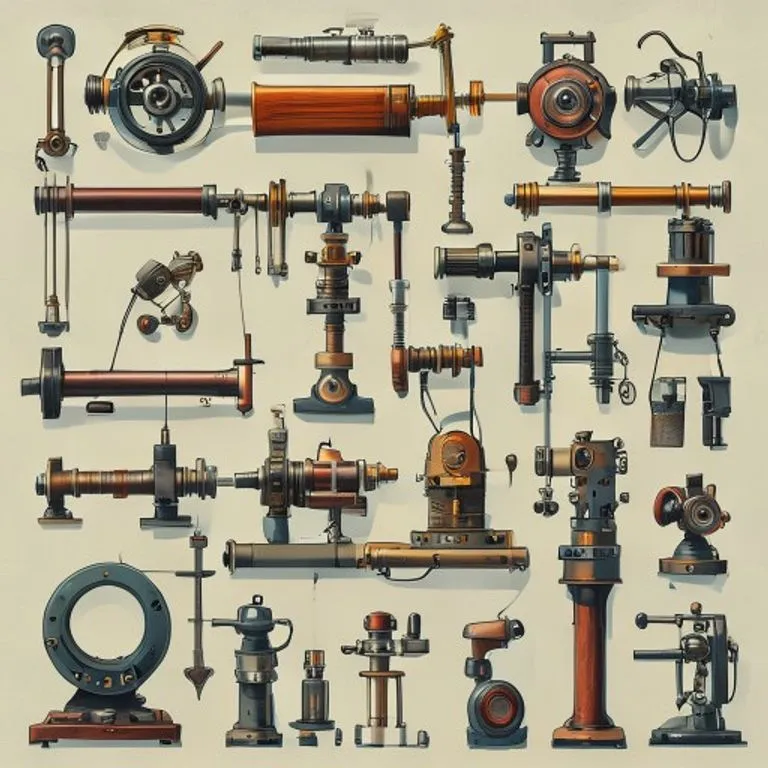
Brief description
Simple machines are fundamental mechanical devices that change the direction or magnitude of a force. They are the building blocks of more complex machines. By using mechanical advantage, they allow humans to perform tasks that would otherwise be impossible due to physical limitations.
Use / Function
- Force Multiplication: Applying a small force over a long distance to move a heavy load over a short distance.
- Distance/Speed Multiplication: Applying a large force over a short distance to move a load a long distance or at high speed.
- Direction Change: Changing the direction of the applied force to make work easier.
Operating principle
All simple machines rely on the conservation of energy. The work put into the machine (Force x Distance) equals the work output (Load x Distance), minus losses due to friction. Mechanical Advantage (MA) is the ratio of the output force to the input force.
The Six Simple Machines
- Lever: A rigid bar resting on a pivot (fulcrum), used to help move a heavy or firmly fixed load with one end when pressure is applied to the other.
- Wheel and Axle: A wheel attached to a smaller axle so that these two parts rotate together in which a force is transferred from one to the other.
- Pulley: A wheel on an axle or shaft that is designed to support movement and change of direction of a taut cable or belt.
- Inclined Plane: A flat supporting surface tilted at an angle, with one end higher than the other, used as an aid for raising or lowering a load.
- Wedge: A triangular shaped tool, and is a portable inclined plane, and one of the six classical simple machines. It can be used to separate two objects or portions of an object, lift up an object, or hold an object in place.
- Screw: A mechanism that converts rotational motion to linear motion, and a torque (rotational force) to a linear force.
How to create it
See the individual pages for construction details of each machine.
Materials needed
Variants and improvements
- Compound Machines: Combining two or more simple machines (e.g., a wheelbarrow combines a wheel and axle with a lever).
- Complex Machines: Modern machinery like engines, cranes, and bicycles are essentially complex arrangements of simple machines.
Limits and risks
- Friction: Real-world efficiency is always less than 100% due to friction between moving parts.
- Material Strength: The machine is only as strong as its weakest component.
- Conservation of Energy: You cannot get more work out than you put in; you trade distance for force (or vice versa).