Generated with AI2 min read
Inclined Plane
Brief description
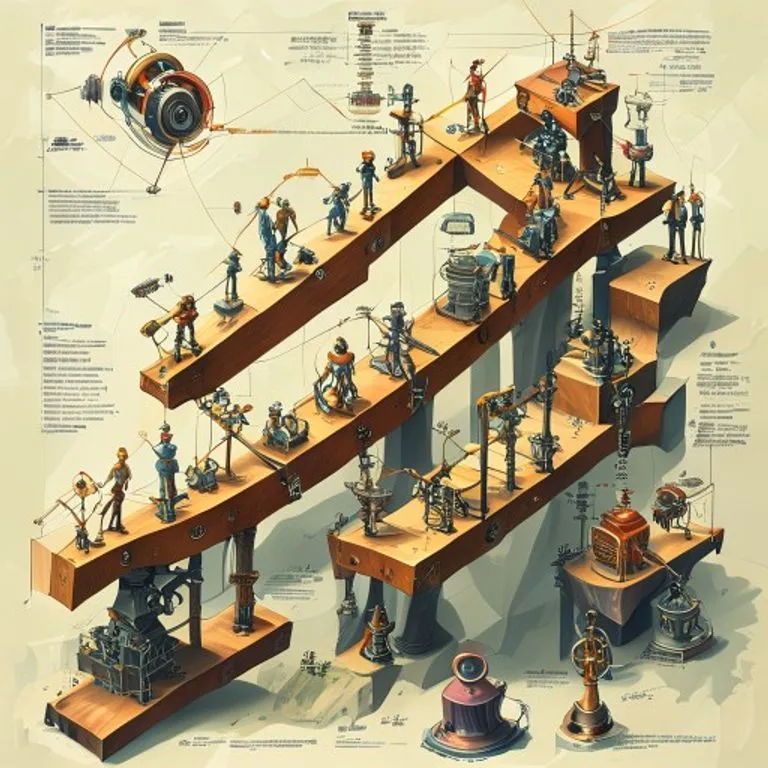
An inclined plane is a flat supporting surface tilted at an angle, with one end higher than the other, used as an aid for raising or lowering a load. It is one of the six classical simple machines.
Use / Function
- Lifting: Moving heavy loads vertically with less force by pushing them up a slope.
- Loading: Ramps for loading cargo onto wagons or ships.
- Accessibility: Paths for wheeled vehicles or people with mobility aids.
Operating principle
The inclined plane allows a load to be lifted by applying a force over a longer distance (the length of the slope) rather than lifting it directly vertical. The mechanical advantage is equal to the length of the slope divided by the height.
How to create it
- Survey: Determine the start and end points of the slope.
- Base: Build up earth or stack stones to create the desired gradient.
- Surface: Smooth the surface with planks, paved stones, or packed earth to reduce friction.
- Support: Ensure the sides are stable and won’t collapse under load.
Materials needed
- Earth: Most common for large ramps.
- Wood: For temporary or movable ramps (planks).
- Stone: For permanent structures.
Variants and improvements
- Ramp: A simple slope.
- Wedge: A portable double inclined plane.
- Screw: An inclined plane wrapped around a cylinder.
Limits and risks
- Friction: A rough surface increases the force needed.
- Length: A gentler slope requires a much longer ramp.
- Stability: Steep earthen ramps can slide or erode.