Generated with AI3 min read
Seed Drill
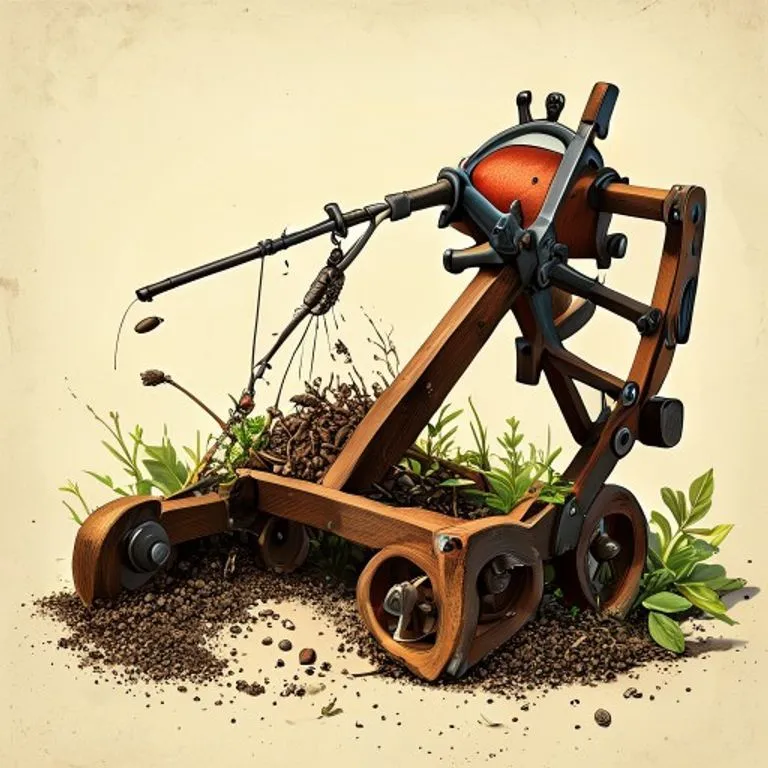
Brief description
A mechanical device that sows seeds for crops by positioning them in the soil and burying them to a specific depth at equal intervals. This ensures that seeds are distributed evenly and at the correct depth, significantly improving germination rates and crop yield compared to broadcast seeding (scattering seeds by hand).
Use / Function
- Primary use: Precise sowing of agricultural seeds.
- Secondary uses: Can be adapted for applying fertilizer simultaneously with the seeds.
- Scale: Local/Farm scale, but its adoption enables mass food production.
Operating principle
The seed drill automates three critical agricultural tasks in a single pass:
- Furrowing: A small plow share (coulter) carves a narrow groove (furrow) in the soil at a consistent depth.
- Metering: A rotating mechanism or gravity-fed tube drops seeds from a hopper into the furrow at a controlled rate.
- Covering: A drag bar, chain, or small harrow follows behind to push soil back over the seeds, protecting them from birds and desiccation.
How to create it
- Minimum functional version: A wooden frame with a seed hopper, a tube leading to a hollowed-out coulter, and a simple internal mechanism (like a fluted roller) to regulate seed flow as the device is pulled.
- Essential components:
- Hopper: To hold the bulk seed.
- Coulter/Drill bit: To open the ground.
- Seed tube: To deliver seed to the bottom of the furrow.
- Drive mechanism: Often geared to the wheels to ensure seeding rate is proportional to travel speed.
- Technical level: Intermediate. Requires basic woodworking and metalworking for the coulter and gears.
Materials needed
- Essential materials:
- Tools:
- Possible substitutes:
- Hardwood coulters (fire-hardened) can substitute for iron in soft soils.
- Bamboo can be used for seed tubes.
Variants and improvements
- Early versions: Multi-tube drills pulled by oxen (ancient Sumeria/China).
- Modern versions: Jethro Tull’s improved drill (1701) introduced the rotating cylinder to meter seeds. Modern industrial drills can sow dozens of rows at once using pneumatic (air) pressure.
- Improvements: Addition of “press wheels” to firm the soil over the seed, and electronic sensors to monitor for clogs.
Limits and risks
- Soil conditions: Does not work well in extremely rocky or wet, clay-heavy soil which can clog the tubes.
- Clogging: Small seeds can bridge in the hopper or block the tubes, leading to “skips” in the field.
- Complexity: More difficult to repair in the field than a simple plow or hand-broadcasting.