Generated with AI3 min read
Hammer
Brief description
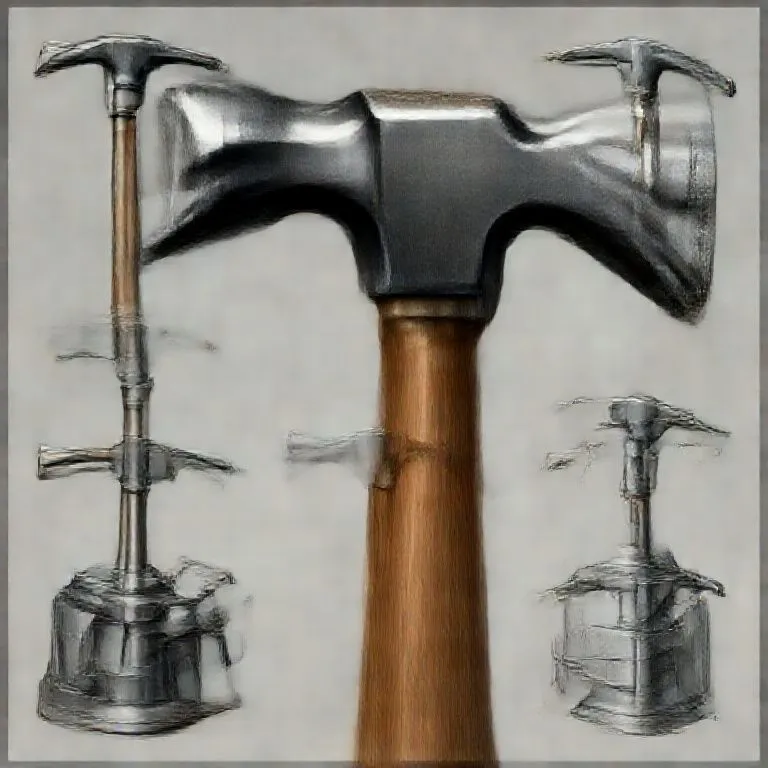
A hammer is a tool that delivers a blow (a sudden impact) to an object. It consists of a weighted “head” fixed to a long handle that is swung to deliver an impact to a small area of an object.
Use / Function
- Construction: Driving nails, fitting parts together (joinery).
- Forging: Shaping hot metal on an anvil.
- Demolition/Breaking: Breaking stones, concrete, or walls.
- Scale: Individual.
Operating principle
It relies on amplification of force and kinetic energy.
- The handle acts as a lever to increase the speed of the head.
- The heavy head stores kinetic energy during the swing, which is released almost instantly upon impact, generating a huge force.
How to create it
- Head Selection:
- Stone: Find a hard, dense stone (granite, basalt) that fits in the hand but has weight.
- Metal: Cast or forge a block of iron/steel with a hole (eye) for the handle.
- Wood: A heavy knot or burl of hard wood (for a mallet).
- Preparation:
- If stone, peck a groove around the middle to prevent the lashing from slipping (grooved axe/hammer style).
- Handle: Select a resilient wooden branch (hickory or ash) that absorbs shock.
- Assembly:
- Lashing (Stone): Split the end of the handle or place the stone against it, then wrap tightly with wet rawhide or sinew. As it dries, it shrinks and tightens.
- Wedging (Metal): Insert the handle into the eye and drive a small wooden or metal wedge into the top of the handle to expand it and lock the head in place.
- Technical level: Basic (Stone) to Intermediate (Metal).
Materials needed
- Essential:
- Head: Stone, Metal, or Hardwood.
- Handle: Shock-absorbing wood.
- Binding: Rawhide, sinew, or rope (for stone hammers).
- Tools: Abrasive stones (for grooving), Knife.
Variants and improvements
- Mallet: A large wooden hammer used for driving chisels or assembling furniture without damaging the surface.
- Sledgehammer: A large, heavy hammer requiring two hands, used for destruction or heavy forging.
- Claw Hammer: Features a fork on the back of the head for pulling nails.
- Trip Hammer: A powered hammer for industrial forging.
Limits and risks
- Recoil: Striking a hard surface can transmit shock to the wrist and arm.
- Safety: The head can fly off if not securely fastened.
- Accuracy: Requires practice to hit the target squarely without damaging the workpiece or fingers.