Generated with AI3 min read
Monowheel
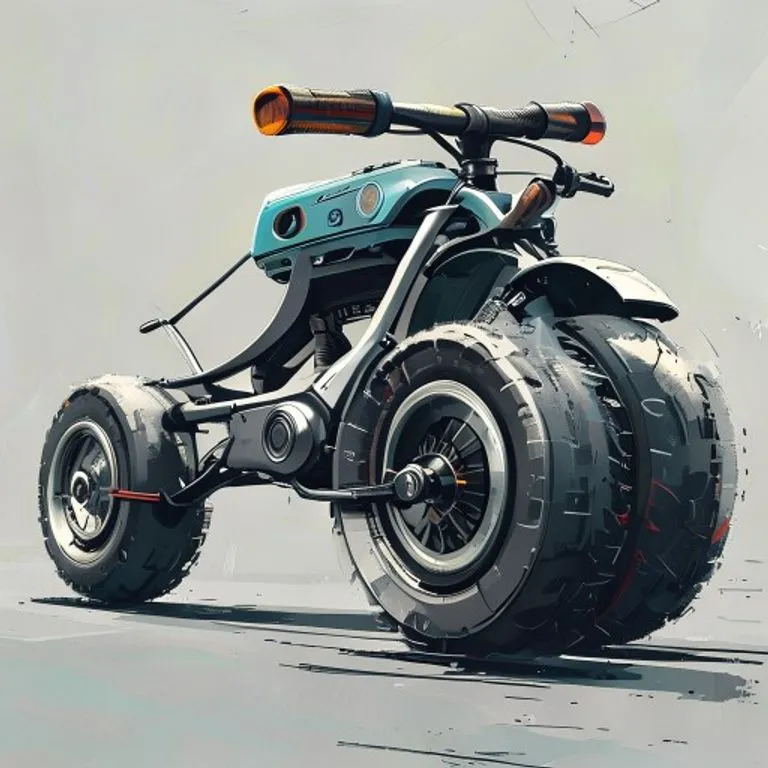
Brief description
A monowheel is a one-wheeled vehicle similar to a unicycle, but instead of sitting above the wheel, the rider sits either inside the wheel or next to it. The wheel is a large ring, usually several feet in diameter, and the rider remains upright while the wheel rotates around them.
Use / Function
- Transportation: Personal transport over various terrains.
- Recreation: Used for entertainment and racing due to its unique riding dynamics.
- Military: Historically experimented with for single-soldier transport or armored variants.
Operating principle
The monowheel relies heavily on the gyroscopic effect and the flywheel effect for stability.
- Stability: As the large wheel spins, it acts as a massive flywheel, resisting tipping over.
- Propulsion: The engine or pedals drive a smaller wheel or gear that presses against the inner rim of the large wheel.
- Steering: Accomplished by the rider shifting their weight (leaning) or, in more complex models, using aerodynamic rudders or shifting the inner frame’s center of gravity.
How to create it
Basic Mechanical Structure
- Outer Ring: A large, rigid circular track (often made of Steel or Iron) that makes contact with the ground. It may have a rubber tire.
- Inner Ring/Frame: A slightly smaller ring or frame that fits inside the outer ring. This frame holds the rider’s seat, engine/pedals, and controls.
- Bearing System: The critical component. The inner frame rides on rollers or Ball and Roller Bearings that run along the inside track of the outer ring. This allows the outer ring to spin while the inner frame remains stationary relative to the ground.
- Drive Mechanism: A friction wheel or gear driven by the engine/pedals that engages with the outer ring to force it to rotate.
Technical level
Advanced. Requires precise bending of large metal tubes and a complex bearing system to reduce friction and maintain alignment.
Materials needed
- Frame: Steel or Iron tubing.
- Tire: Rubber or solid rubber for traction.
- Bearings: High-quality Ball and Roller Bearings or custom rollers.
- Seat: Leather or padded seat.
Variants and improvements
- Pedal-powered: Driven by human power, similar to a bicycle. Hard to achieve high speeds needed for stability.
- Motorized: Uses a gasoline engine or electric motor.
- Armored: Historical concepts (“War Tank”) where the rider is protected inside a solid shell.
Limits and risks
- “Gerbiling” (Hamster Effect): If the rider accelerates or brakes too hard, the force can cause the inner frame (and rider) to spin inside the wheel instead of moving the vehicle forward. This acts like a pendulum.
- Vision: The wheel itself can obstruct the rider’s forward view.
- Steering: Very difficult to steer compared to a bicycle; turning radius is usually large.
- Braking: Sudden braking causes the rider to spin forward (gerbiling).