Generated with AI3 min read
Gyroscope
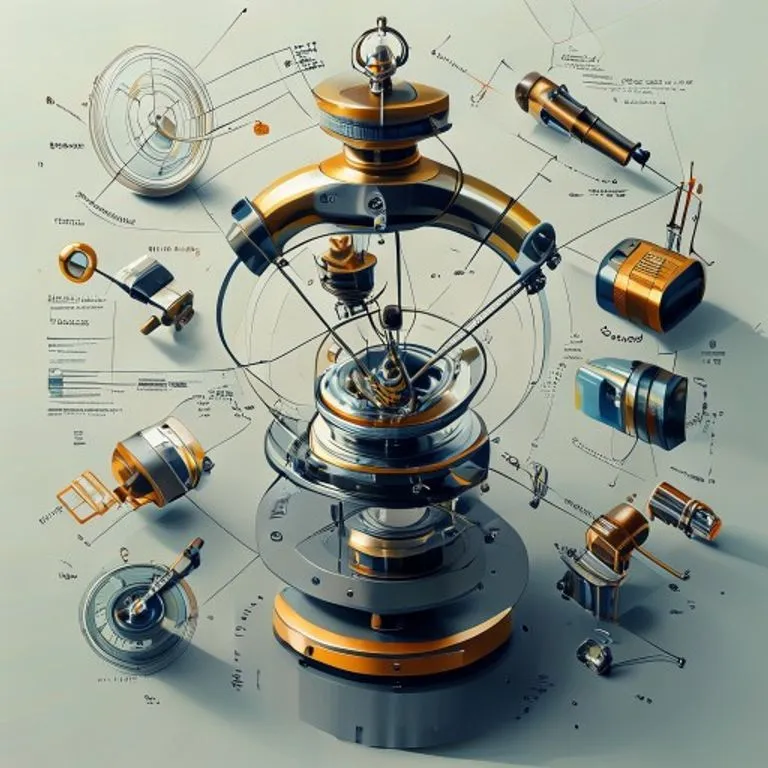
Brief description
A gyroscope is a device consisting of a wheel or disc mounted so that it can spin rapidly about an axis which is itself free to alter in direction. The orientation of the axis is not affected by tilting of the mounting, so gyroscopes can be used to provide stability or maintain a reference direction in navigation systems, automatic pilots, and stabilizers.
Use / Function
- Navigation: Maintains a fixed direction, essential for gyrocompasses in ships and aircraft where magnetic compasses are unreliable.
- Stabilization: Used in ships (gyrostabilizers) and monorail trains to prevent rolling.
- Guidance: Critical component in inertial guidance systems for missiles and spacecraft.
- Toys/Education: Demonstrates principles of angular momentum and precession.
Operating principle
The operation relies on conservation of angular momentum. A spinning wheel (the rotor) resists changes to its axis of rotation.
- Rigidity in Space: Once spinning, the gyroscope’s axle wants to keep pointing in the same direction, regardless of how the frame moves.
- Precession: If you try to tilt the spinning axis, it doesn’t tilt directly; instead, it moves perpendicular to the force applied. This phenomenon is called precession.
How to create it
Basic Mechanical Gyroscope
- Rotor (Flywheel): Create a perfectly balanced, heavy wheel (rotor), typically of Brass or Steel. Ideally, concentrate the mass at the rim.
- Axle: Mount the rotor on a precision Axle. Friction must be minimized.
- Gimbals: Mount the axle in a ring (inner gimbal). Mount that ring in another ring (outer gimbal) with pivots at 90 degrees. This allows the rotor to remain independent of the frame’s motion.
- Bearings: Use high-quality Ball and Roller Bearings or Slide Bearings for the rotor axle and gimbal pivots to minimize friction.
Materials needed
- Heavy Mass: Brass, Steel, or Lead (for the rim).
- Frame: Brass, Aluminum, or dense Wood.
- Bearings: Steel or hard Stone (jewel bearings).
Variants and improvements
- Mechanical Gyroscope: The classic spinning wheel type.
- Optical Gyroscope: Uses lasers (Ring Laser Gyroscope) or fiber optics; has no moving parts and is extremely precise.
- MEMS Gyroscope: Micro-Electro-Mechanical Systems, found in smartphones and modern electronics. Tiny vibrating structures detect rotation.
Limits and risks
- Friction: Any friction in the bearings will eventually cause the gyroscope to slow down and precess (drift) away from its target orientation.
- Gimbal Lock: In a three-gimbal system, if two gimbals align parallel to each other, the gyroscope loses a degree of freedom and can “lock,” losing its stability.
- Power: Mechanical gyroscopes require a constant power source (electric motor or air jet) to keep spinning.