Generated with AI3 min read
Drill Bit
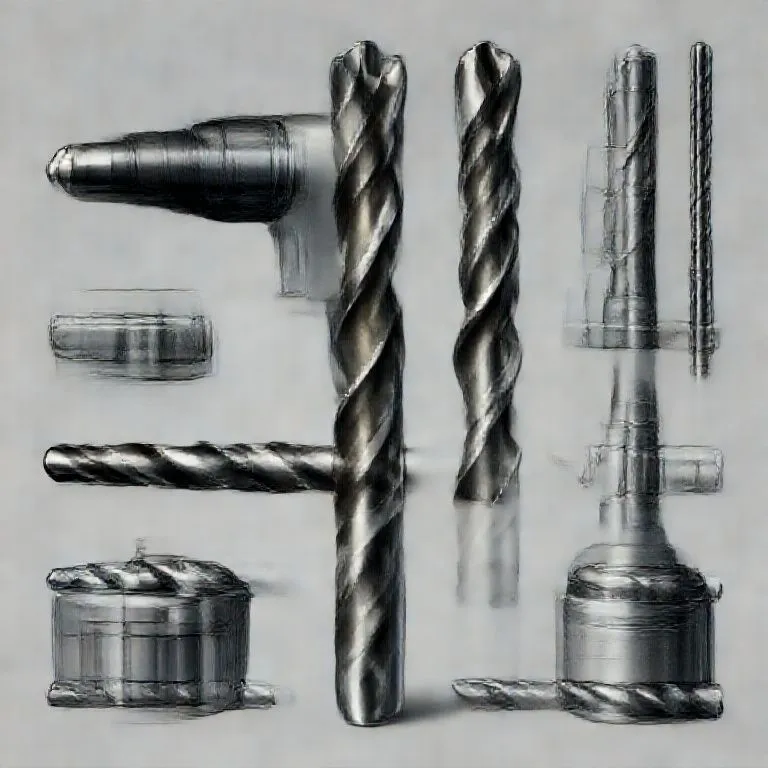
Brief description
A drill bit is a cutting tool used to remove material to create holes, almost always of circular cross-section. Drill bits come in many sizes and shapes and can create different kinds of holes in many different materials.
Use / Function
The primary use of a drill bit is to cut holes in solid materials.
- Primary use: Drilling holes in wood, metal, plastic, and stone.
- Secondary uses: Reaming (enlarging existing holes), countersinking.
- Scale: Used in everything from delicate jewelry making to massive industrial mining operations.
Operating principle
The drill bit acts as a rotating cutting edge.
- Rotation: The bit is rotated by a drill (Hand Drill or Drill Press).
- Axial Force: Pressure is applied along the axis of the bit into the work material.
- Shearing/Chipping: The cutting edges of the bit shear off material (in metal/wood) or chip it away (in stone), while the flutes (grooves) help evacuate the debris (chips/dust) from the hole.
How to create it
Minimum functional version
A simple hard stone (Flint) flake with a sharp point can serve as a primitive drill bit for softer materials like wood or bone.
Intermediate version
A metal rod (Copper, Bronze, Iron) flattened at the tip and sharpened into a spear-point shape.
Advanced version
Twist drills made of hardened Steel or High Speed Steel. This requires:
- Forging a steel rod.
- Twisting it while hot to create flutes (for chip removal).
- Hardening and tempering the steel to hold an edge without shattering.
- Sharpening the tip to the correct cutting angle.
Materials needed
- Essential materials: Hard material (Flint, Obsidian, Copper, Bronze, Iron, Steel).
- Tools: Hammer, Anvil, Files (for shaping metal), Grinding Wheel (for sharpening).
Variants and improvements
- Spoon bit: An early type of bit shaped like a gouge, good for wood.
- Twist bit: The modern standard, with helical flutes to remove chips.
- Masonry bit: Has a Tungsten Carbide tip for drilling into stone or concrete.
- Auger: A large wood-boring bit with a screw tip to pull itself into the wood.
Limits and risks
- Overheating: Friction generates heat, which can ruin the temper of a steel bit or burn the material being drilled. Use lubricant (water, oil).
- Breaking: Bits are hard but brittle. Lateral force can snap them.
- Jamming: If chips are not cleared, the bit can get stuck.