Generated with AI3 min read
Cotton Gin
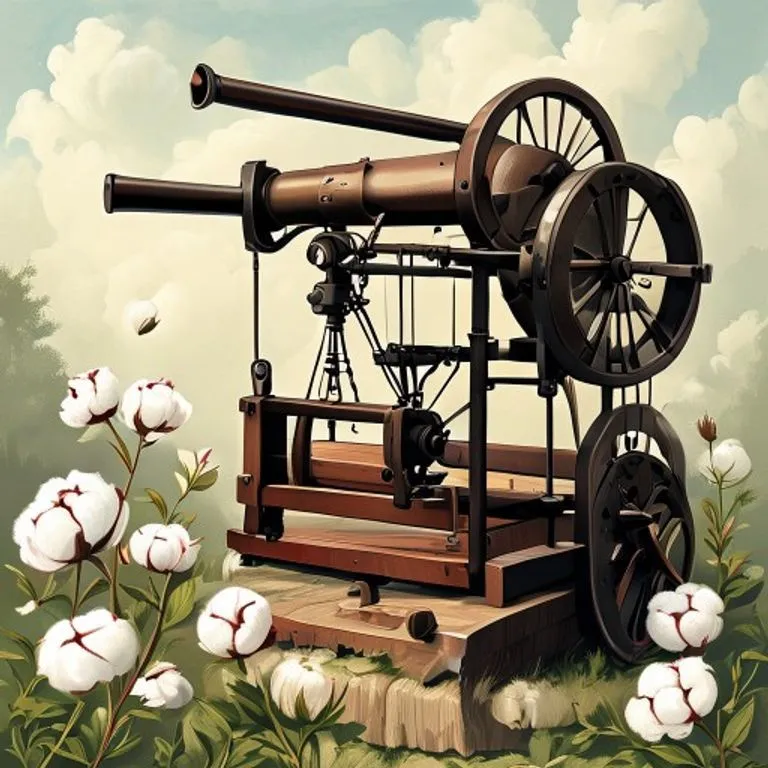
Brief description
The cotton gin is a machine that quickly and easily separates cotton fibers from their seeds, enabling much greater productivity than manual separation. It was a key invention of the Industrial Revolution.
Use / Function
- Seed separation: Efficiently removes the sticky seeds from the fluffy cotton fibers.
- Scale: From small hand-cranked machines to large industrial facilities.
- Productivity: Allows one person to process significantly more cotton per day than by hand.
Operating principle
The machine uses a combination of a wire screen and small wire hooks to pull the cotton through, while brushes continuously remove the loose cotton lint to prevent jams.
- Feeding: Raw cotton with seeds is fed into the top of the machine.
- Hooking: A rotating drum with wire hooks (or saws in later versions) pulls the cotton fibers through narrow slots in a metal grid.
- Separation: The slots are too narrow for the seeds to pass through, so they are stripped off and fall away.
- Cleaning: A set of rotating brushes (the “doffer”) removes the clean fiber from the hooks, collecting it for further processing.
How to create it
- Build a frame: Construct a sturdy box or frame from Wood.
- Create the cylinder: Make a wooden cylinder and embed rows of wire hooks or circular saw blades made of Iron.
- Install the grid: Fix a metal plate with narrow slits that match the spacing of the hooks.
- Add brushes: Create a second rotating cylinder with stiff bristles to clear the hooks.
- Power source: Attach a hand crank or a pulley system to connect to a Water wheel or Steam engine.
- Technical level: Intermediate (requires precise alignment of hooks and slots).
Materials needed
- Essential: Wood for the frame and cylinders, Iron for the hooks/saws and the grid.
- Substitutes: Hardwood for some of the mechanical parts if iron is scarce, but the grid and hooks should ideally be metal for durability.
- Tools: Saw, Hammer, Drill Bit, and metal-working tools.
Variants and improvements
- Churka Gin: An ancient manual roller gin used in India for long-staple cotton.
- Saw Gin: Uses circular saws to pull fibers, more efficient for short-staple cotton (Eli Whitney’s design).
- Industrial Gin: Large-scale, automated versions powered by external engines.
Limits and risks
- Fiber damage: The aggressive action of the hooks can sometimes break or weaken the cotton fibers.
- Mechanical jams: Sticky or wet cotton can clog the mechanism.
- Safety: Rotating parts and sharp hooks pose a risk of injury to the operator’s hands.
- Social impact: Historically, the increased efficiency of the cotton gin led to a massive expansion of cotton plantations and, unfortunately, the intensification of slavery in the American South.