Generated with AI3 min read
Bridge
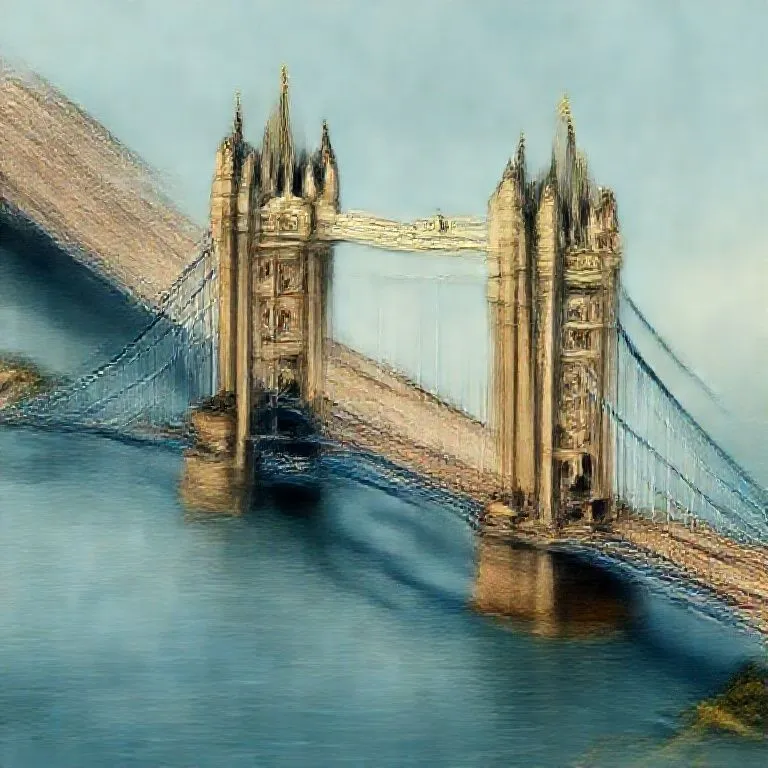
Brief description
A structure built to span a physical obstacle (such as a body of water, valley, road, or rail) without blocking the way underneath. It provides passage over the obstacle.
Use / Function
- Transportation: Allows people, animals, and vehicles to cross rivers, valleys, or other roads.
- Trade: Facilitates the movement of goods between separated regions.
- Communication: Connects communities that would otherwise be isolated.
- Scale: From small footbridges to massive multi-kilometer industrial viaducts.
Operating principle
Bridges work by balancing forces:
- Compression: Pushing forces (common in arch and stone bridges).
- Tension: Pulling forces (common in suspension and rope bridges).
- Bending: The tendency of a beam to sag when loaded (common in simple beam bridges).
- Shear: Sliding forces.
The structure transfers the load (Dead Load: weight of bridge + Live Load: traffic) to the ground through piers, abutments, or towers.
How to create it
- Survey: Choose stable ground on both sides of the obstacle.
- Foundation: Dig down to bedrock or stable soil. For water crossings, cofferdams or piles may be needed.
- Substructure: Build the piers or abutments that will support the bridge.
- Superstructure: Construct the span (beams, arches, or cables) connecting the supports.
- Deck: Lay the flooring surface for traffic.
Basic Types creation:
- Beam Bridge: Place a rigid beam (log, stone slab) across two supports. Limited span.
- Arch Bridge: Build a temporary wooden support (centering). Lay stones/bricks from both sides until they meet at the top (keystone). Remove centering.
- Suspension Bridge: Anchor strong ropes/cables on both banks. Hang the deck from these main cables.
Materials needed
- Essential:
- Wood: For short spans, temporary bridges, or truss elements.
- Stone/Brick: For durable arch bridges (requires mortar).
- Rope/Cables: For suspension bridges.
- Concrete/Steel: For modern, long-span bridges.
- Tools: Saws, chisels, hammers, cranes (pulleys), levels.
Variants and improvements
- Log Bridge: The simplest form.
- Clapper Bridge: Stone slabs on stone piers (ancient).
- Arch Bridge: Roman invention, extremely durable.
- Truss Bridge: Uses triangles (wood or metal) to distribute weight efficiently.
- Suspension Bridge: Allows for the longest spans (e.g., Golden Gate).
- Cable-Stayed Bridge: A modern variant with cables connected directly to towers, ideal for medium to long spans.
- Cantilever Bridge: Built using structures that project horizontally into space, supported on only one end.
- Movable Bridge: Drawbridges to allow boat traffic.
Limits and risks
- Resonance: Rhythmic marching or strong winds can cause the bridge to vibrate and collapse (e.g., Tacoma Narrows).
- Scour: Water moving fast around piers can wash away the foundation.
- Overload: Exceeding the weight limit causes structural failure.
- Corrosion/Rot: Wood rots, iron rusts. Maintenance is crucial.