Generated with AI3 min read
Cable-Stayed Bridge
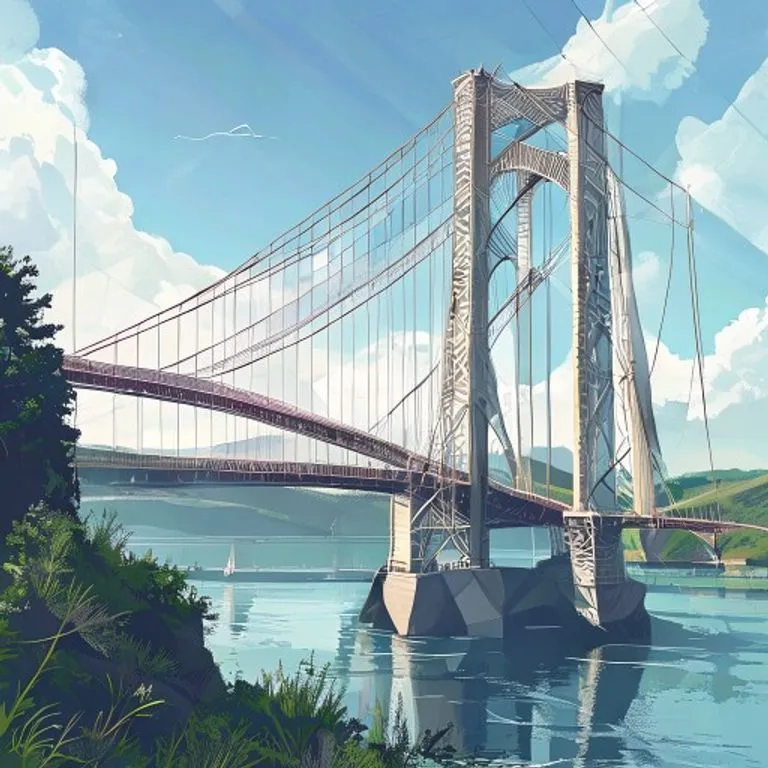
Brief description
A modern bridge design consisting of one or more towers (or pylons), from which cables support the bridge deck. It is distinct from a suspension bridge because the cables run directly from the tower to the deck, rather than hanging from a main cable.
Use / Function
- Medium to Long Spans: Ideal for spans longer than cantilever bridges but shorter than suspension bridges (approx. 200m to 1000m).
- Aesthetics: Often chosen for their striking, modern appearance.
- Efficiency: Requires less material than a suspension bridge for medium spans.
Operating principle
The cable-stayed bridge works by tension and compression:
- Cables (Tension): The cables pull the deck up, transferring the weight of the traffic and the deck itself to the towers.
- Towers (Compression): The towers support the vertical load from the cables and transfer it to the foundation.
- Deck (Compression): The horizontal component of the cable force compresses the deck towards the towers.
Unlike an Arch which relies entirely on compression to span a gap, the cable-stayed bridge relies on the high tensile strength of steel cables.
How to create it
- Foundations: Build strong foundations for the towers (pylons) and the anchorages at the ends of the deck.
- Towers: Construct the vertical towers (usually reinforced concrete or steel).
- Deck & Cables: Build the deck outwards from the tower in balanced sections.
- Install a segment of the deck.
- Attach the corresponding stay cable to the tower and tension it.
- Repeat on the other side to keep the tower balanced.
- Closure: Join the deck sections in the middle.
Materials needed
- Essential:
- Steel Cable: High-strength strands are critical.
- Concrete: For towers and deck.
- Steel: For reinforcement, towers, or deck structure.
- Tools: Heavy cranes, hydraulic jacks (for tensioning cables), formwork.
Variants and improvements
- Harp Design: Cables are parallel to each other.
- Fan Design: Cables all connect to the top of the tower (more efficient).
- Single Tower: Asymmetric designs for specific aesthetic or structural needs.
- Extradosed Bridge: A hybrid between a girder bridge and a cable-stayed bridge, with shorter towers and stiffer deck.
Limits and risks
- Wind: Like suspension bridges, they are susceptible to aerodynamic instability (flutter).
- Cable Vibration: Rain and wind can cause cables to vibrate violently; dampers are needed.
- Complexity: Requires precise engineering to balance the forces during construction.
- Corrosion: The cables are the critical weak point; if they rust, the bridge fails.