Generated with AI2 min read
Abacus
Brief description
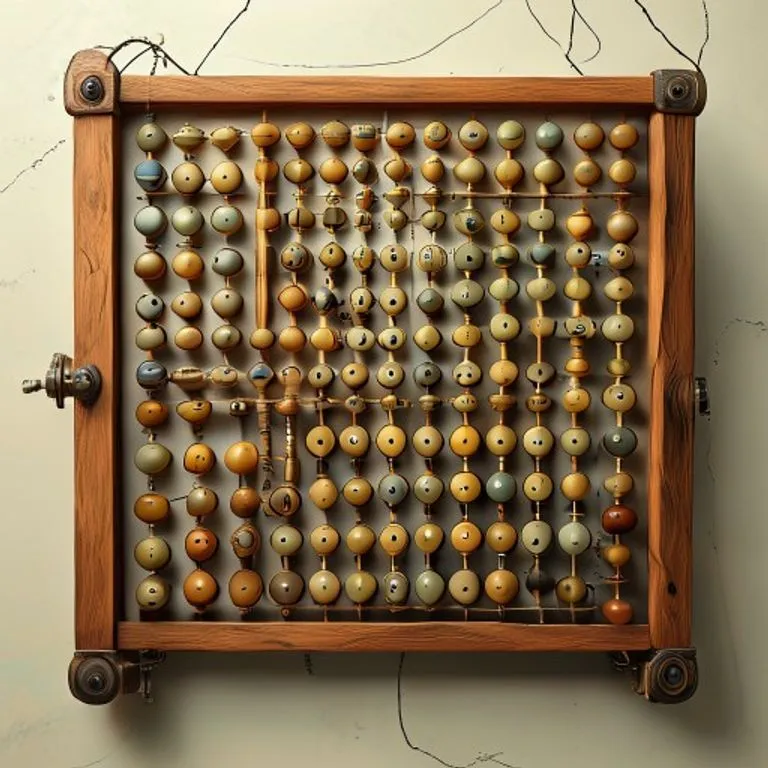
The abacus is a manual calculating tool that uses beads or stones moved along rods or grooves to perform arithmetic operations. It is one of the oldest known computational devices, predating the written Hindu-Arabic numeral system.
Use / Function
- Calculation: Performing addition, subtraction, multiplication, and division.
- Education: Teaching the concepts of place value and arithmetic to students.
- Commerce: Rapidly calculating prices and totals in markets and shops.
- Scale: Individual and domestic use.
Operating principle
The abacus exploits the concept of place value. Each rod or wire represents a different power of ten (units, tens, hundreds, thousands, etc.). By moving beads to represent numbers and following specific algorithms for shifting them during operations, complex calculations can be performed quickly.
How to create it
- Minimum functional version: A series of grooves in the sand with small stones (calculi) moved within them.
- Essential: A frame to hold the components together and a set of movable counters.
- Technical level: Basic.
Materials needed
- Essential materials:
- Tools:
- Possible substitutes:
Variants and improvements
- Roman Abacus: Used grooves in a metal plate with sliding counters.
- Suanpan (Chinese): Usually has two beads on the upper deck and five on the lower deck (2:5 system), allowing for hexadecimal calculations.
- Soroban (Japanese): Improved version with a 1:4 bead configuration, optimized for the decimal system.
- Schoty (Russian): Uses horizontal rods and a 10-bead system.
Limits and risks
- Training: Requires significant practice to achieve high speeds and accuracy.
- Manual Error: A slip of the finger can change the result of a long calculation.
- No Memory: Unlike modern computers, it does not store intermediate results or steps unless recorded elsewhere.