SyntheticGenerated with AI3 min read
Primitive Cement
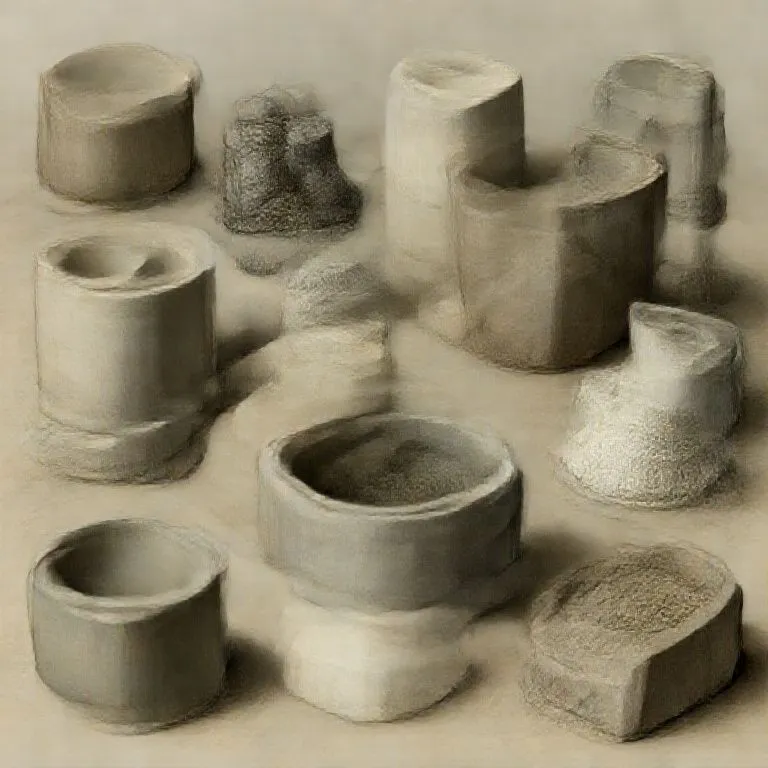
Primitive cement, often known as Roman Cement or Roman Concrete (Opus Caementicium), is the technology that allowed ancient civilizations to build structures that have survived millennia, even underwater. Unlike simple lime mortar, this cement is hydraulic: it sets and hardens due to a chemical reaction with water, not by drying in the air.
Description of what it is like
A dense, sticky paste, usually grayish or reddish (depending on the pozzolana used). Upon hardening, it becomes a monolithic mass similar to volcanic rock, extremely hard and waterproof.
Origin and where to find it
It is a synthetic composite material. It is not found in nature, but its ingredients are.
- Key Ingredients:
Minimum processing required
- Lime Preparation: Burn limestone to make quicklime and then slake it with water to get lime putty.
- Pozzolana Preparation: Collect volcanic ash or crush old bricks/tiles until a fine powder is obtained.
- Dry Mixing: Mix 1 part lime with 2-3 parts pozzolana.
- Activation: Add water and mix vigorously.
- Placement: Pour immediately mixed with aggregates (stones, gravel) to make concrete.
Tools needed to work on it
- Lime Kiln: To produce the lime.
- Mills/Mortars: To pulverize the pozzolana.
- Hoes and Troughs: For mixing.
- Rammers: To compact the mixture into forms (vital for strength).
Common forms of use
- Roman Concrete: Mixture of primitive cement with caementa (fist-sized stones). Used for domes (Pantheon), aqueducts, and walls.
- Waterproof Coating: To seal the inside of cisterns and pipes.
- Bonding Mortar: To stick bricks in very humid environments where normal lime mortar would not dry.
Possible substitutes
- Lime Mortar: If water resistance is not required.
- Clay: For simple structures (adobe), but washes away with rain.
- Cement (Portland): The modern version, stronger but harder to manufacture (requires 1450°C vs 900°C for lime).
Limitations and common failures
- Setting Time: It is slower than modern cement. It may take weeks or months to reach full hardness.
- Poor Mixing: If the pozzolana is not fine enough, the reaction will not occur fully.
- Proportion: Too much lime weakens the mix. Pozzolana should predominate.
Risks and safety
- Alkalinity: Lime is caustic. Protect your eyes and skin.
- Heat: Slaking lime generates a lot of heat.
Related materials
Properties
- Hydraulic (sets underwater)
- Waterproof
- Durable
- High strength
Used for
- Roman Concrete
- Cisterns
- Ports and piers
- Wet foundations
Manufacturing / Process
Mixing slaked lime with pozzolana (volcanic ash or crushed brick) and water.