NaturalGenerated with AI3 min read
Horn
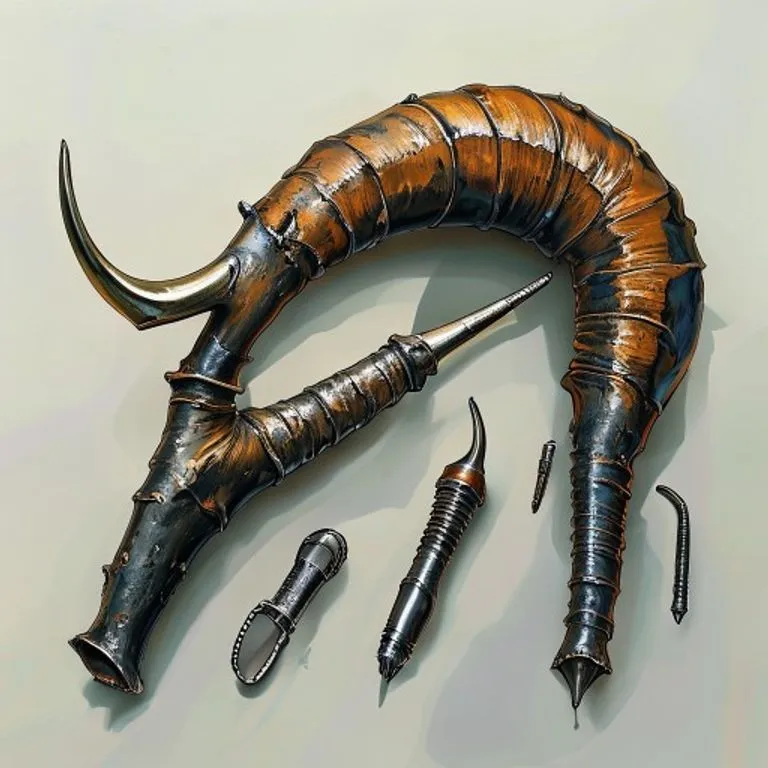
Horn is a hard, permanent outgrowth found on the heads of cattle, sheep, goats, and buffalo. It consists of a sheath of keratin (the same protein as hair and fingernails) covering a living bone core. It was one of humanity’s first thermoplastics.
Description of what it is like
- Appearance: Ranges from black, grey, and brown to translucent pale yellow or white. Often has a grain or layers.
- Texture: Smooth when polished, fibrous if broken.
- Properties: It is tough and resilient. Uniquely, when heated (boiled or roasted), it becomes soft and pliable, allowing it to be flattened, molded, or welded together. When it cools, it retains the new shape.
Origin and where to find it
- Source: Domesticated cattle, oxen, sheep, goats, and water buffalo.
- Distinction: Unlike Antler (which is solid bone and shed annually by deer), horn is hollow (once the core is removed) and permanent.
Minimum processing required
- Removal: The horn is removed from the animal (usually after slaughter).
- Maceration: Left to rot or boiled so the inner bony core separates from the keratin sheath.
- Cleaning: Scraped to remove dirt and outer rough layers.
- Heating: Boiled in water or heated over a fire to soften the keratin.
- Shaping:
- Flattening: Slit open and pressed between hot plates to make flat sheets (for combs, lantern panes).
- Molding: Pressed into molds for spoons or cups.
- Welding: Two pieces can be fused together under heat and pressure.
Tools needed to work on it
- Saw: To cut the horn to length.
- Cauldron: For boiling water/oil to soften it.
- Vise/Press: To flatten or mold the hot horn.
- Scrapers/Knives: To smooth the surface.
- Abrasives: Sand or Pumice for polishing.
Common forms of use
- Solid: Tips are solid and used for handles or buttons.
- Hollow: The main body is used for cups (drinking horns) or powder horns.
- Sheet: Flattened horn is used for Combs, spectacle frames, and before glass, as translucent windows for lanterns.
- Composite: Layers of horn are used on the belly of composite bows to store energy.
Possible substitutes
- Plastic: The modern synthetic equivalent.
- Bone: Harder and brittle, cannot be molded with heat.
- Wood: Easier to work but lacks the thermoplastic properties and translucency.
- Tortoiseshell: A similar keratin material, but from turtles (often illegal/unethical now).
Limitations and common failures
- Delamination: Old or dried-out horn can peel in layers.
- Insects: Keratin is food for clothes moths and carpet beetles.
- Heat: Will warp if exposed to heat again. Smells like burning hair when burned.
Risks and safety
- Burns: Working with boiling water and hot horn.
- Dust: Breathing keratin dust during sanding can be irritating.
Related materials
Properties
- Thermoplastic
- Tough
- Fibrous
- Translucent (when thin)
Used for
- Drinking vessels
- Combs
- Spectacle frames
- Bows (composite)
- Lantern windows
- Buttons
- Glue
Manufacturing / Process
Harvested from bovids, boiled to remove the core, and shaped with heat.