Basic Weaving
Brief description
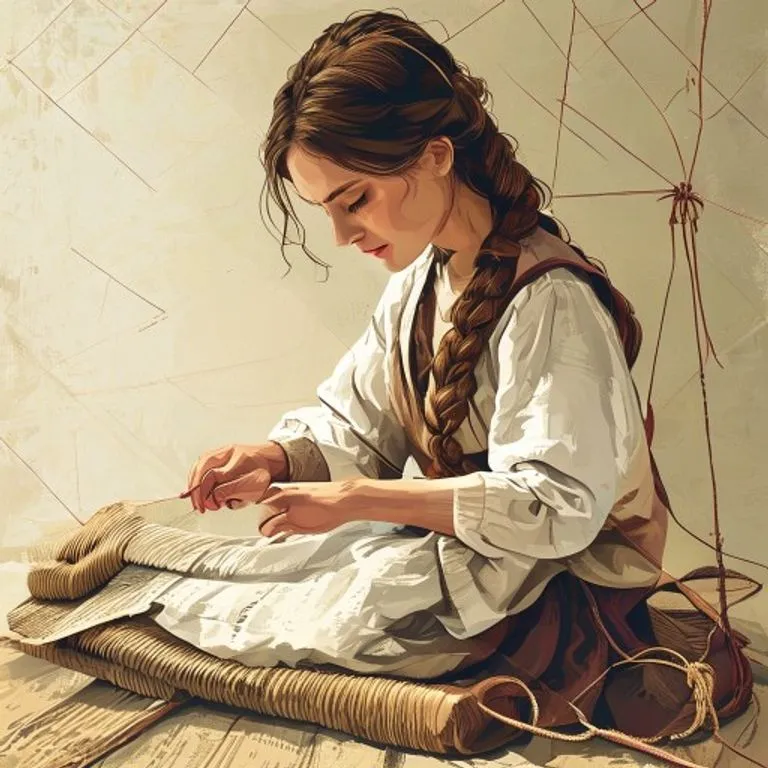
Weaving is the method of textile production in which two distinct sets of yarns or threads are interlaced at right angles to form a fabric or cloth. It is one of the primary methods of creating durable, flexible materials for human use.
Use / Function
- Fabric Production: Creating materials for clothing, bedding, and upholstery.
- Structural Uses: Making sails for ships, tents for shelter, and bags for transport.
- Industrial Applications: Creating reinforced belts, filters, and heavy-duty canvas.
- Artistic Expression: Tapestries and decorative textiles.
Operating principle
The core principle of weaving is the interlacing of two sets of threads:
- Warp: The set of longitudinal threads held in tension on a frame or loom.
- Weft (or Woof): The set of transverse threads that are passed over and under the warp threads.
The pattern of interlacing (the weave) determines the characteristics of the resulting fabric:
- Plain Weave: Each weft thread passes over one warp thread and under the next. Strong and simple.
- Twill Weave: Weft threads pass over one or more warp threads and then under two or more, creating a diagonal ribbing. Flexible and durable (like denim).
- Satin Weave: Long “floats” of weft or warp threads create a smooth, lustrous surface.
How to implement
1. Preparation (Warping)
The warp threads must be measured to the desired length and kept at even tension. They are then attached to the loom.
2. Shedding
A space (the shed) is created between the warp threads. Traditionally, this is done by lifting every other warp thread.
3. Picking
The weft thread, usually carried on a shuttle, is passed through the shed.
4. Battening (Beating-up)
A comb-like tool or a bar (the reed) is used to push the newly laid weft thread tightly against the previous one, ensuring a dense, stable fabric.
Materials needed
- Essential: Yarn or Thread.
- Fibers: Wool, Cotton, Linen, Silk, or Plant Fibers.
- Tools:
- Loom: To hold the warp in tension.
- Shuttle: To carry the weft thread.
- Reed/Comb: To pack the weft threads.
Variants and improvements
- Backstrap Weaving: Using the body’s weight to provide tension; portable and simple.
- Horizontal/Vertical Looms: Fixed frames allowing for larger and more complex fabrics.
- Flying Shuttle: A mechanical improvement that allows the shuttle to be “thrown” across the loom, greatly increasing speed.
- Jacquard Weave: A complex system (precursor to binary code) for weaving intricate patterns automatically.
Limits and risks
- Tension Control: Uneven tension in the warp leads to distorted or weak fabric.
- Time Intensive: Manual weaving is a slow process requiring patience and precision.
- Fraying: Raw edges of woven fabric will unravel unless secured (selvedge or hemming).
- Physical Strain: Long hours of weaving can cause repetitive strain injuries in the back, shoulders, and hands.