Generated with AI3 min read
Water Turbine
Brief description
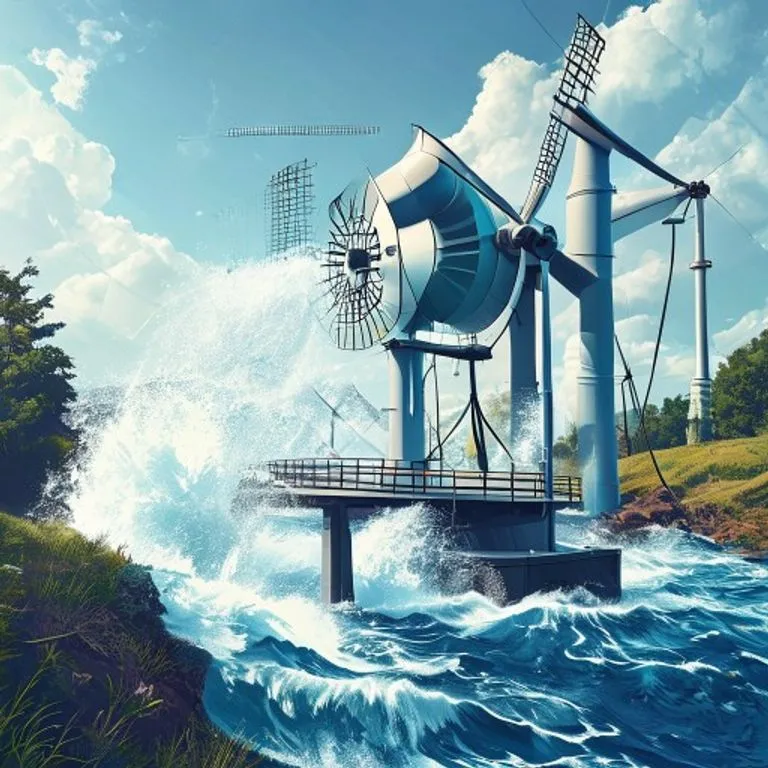
A water turbine is a rotary machine that converts the kinetic and potential energy of falling or flowing water into mechanical work. It is the core component of hydroelectric power systems, driving generators to produce electricity.
Use / Function
- Power Generation: Driving Electric Generators to produce electricity.
- Mechanical Work: Powering mills, factories, or pumps directly.
- Large-scale Energy: Capable of harnessing immense power from rivers and dams.
Operating principle
Water turbines exploit the momentum of moving water to rotate a shaft:
- Pressure/Velocity: Water is directed at the turbine blades via a nozzle or guide vanes.
- Impulse or Reaction:
- Impulse Turbines (like the Pelton wheel) use the velocity of a jet hitting the blades in open air.
- Reaction Turbines (like Francis or Kaplan) are submerged and react to pressure changes as water flows through the casing.
- Rotation: The force of the water causes the runner (the part with blades) to spin.
- Transfer: The spinning runner turns a shaft connected to a load (like a generator).
How to create it
Simple Impulse Turbine (Pelton style)
- The Runner: Create a heavy wheel from Iron or strong Wood.
- The Buckets: Attach cup-shaped blades (buckets) around the rim. These should have a central ridge to split the water jet for maximum efficiency.
- The Nozzle: Construct a tapered pipe that narrows at the end to increase water velocity.
- The Shaft: Mount the wheel on a sturdy Steel or iron axle supported by Bearings.
- Directing Flow: Aim the water jet precisely at the buckets to induce rotation.
Materials needed
- Blades/Runner: Iron or Steel for durability; Wood for low-head, primitive versions.
- Axle: Strong Steel or Iron.
- Housing: Concrete, Stone, or metal to contain and direct water.
- Bearings: Essential for reducing friction.
Variants and improvements
- Water Wheel: The ancestor; operates at lower speeds and efficiency. See Water Wheel.
- Pelton Wheel: Best for high-head (high vertical drop) applications.
- Francis Turbine: Most common for medium-head applications; operates fully submerged.
- Kaplan Turbine: Efficient for low-head applications (like large rivers with small drops).
Limits and risks
- Erosion: Sand and debris in the water can wear down blades over time (cavitation).
- Environment: Can disrupt local ecosystems and fish migration if not designed with bypasses.
- Infrastructure: Requires significant construction (dams, pipes/penstocks) to create the necessary water pressure.
- Scale: Extremely heavy and difficult to balance at high speeds.