Generated with AI3 min read
Water Frame
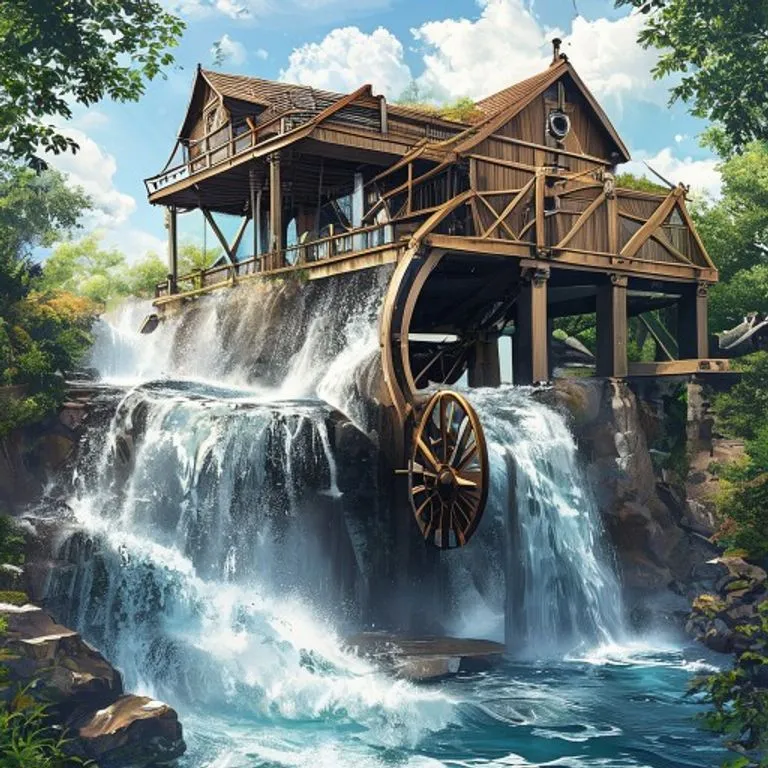
Brief description
The water frame is a large water-powered spinning frame designed to spin thread or yarn from coarse fibers such as cotton or wool mechanically. Patented by Richard Arkwright in 1769, it produced strong, hard thread suitable for the warp (longitudinal threads) of woven cloth, accelerating the shift from domestic cottage spinning to factory-based textile manufacturing.
Use / Function
- Industrial Spinning: Produces uniform, high-strength yarn suitable for warp threads without requiring hand spinning skills.
- Factory Automation: Driven by continuous water power (or steam), replacing human labor for driving the spinning mechanism.
- Continuous Yarn Production: Operates multiple sets of rollers simultaneously to process multiple strands of roving in a continuous sequence.
Operating principle
- Water Wheel Power: Motion from a water wheel or turbine turns a main central shaft and gearing system.
- Roller Drawing: Roving (loosely twisted fiber) passes through three consecutive pairs of rollers, each pair rotating faster than the preceding pair to stretch and thin the fibers.
- Twisting and Winding: The drawn fibers travel to a flyer and bobbin mechanism, where rotation twists the roving into strong yarn and winds it onto a bobbin.
How to create it
- Frame Assembly: Construct a heavy timber frame of Wood capable of absorbing vibration from multiple mechanical sets.
- Drive System: Mount a central shaft driven by a belt or gearing linked to a Water Wheel or water turbine.
- Roller Sets: Install sets of paired metal rollers driven by differential gears made of Iron or Cast Iron.
- Flyer and Bobbin Units: Position vertical spindle assemblies with metal flyers and wooden bobbins connected via drive bands made of Plant fibers.
- Feed & Tension Adjustment: Fit tensioning cords and roving guides to control thread thickness and ensure uniform winding.
Materials needed
- Frame: Heavy hard Wood (oak or beech).
- Rollers & Gears: Iron and Cast Iron.
- Belts & Cords: Plant fibers or leather.
Variants and improvements
- Spinning Jenny: A hand-powered predecessor capable of spinning multi-strand yarn, though weaker and suited primarily for weft threads.
- Spinning Mule: A later hybrid invention combining the roller-drawing system of the water frame with the moving carriage of the spinning jenny for superior yarn fineness and strength.
Limits and risks
- Power Requirement: Too heavy and cumbersome to be operated by hand; requires a constant, reliable water flow or steam engine.
- Fixed Yarn Size: Less adaptable than hand spinning for producing varied yarn thicknesses without changing roller gears.
- Mechanical Friction: Unlubricated rollers or dry drive belts can cause thread breakage or mechanical jamming.