Generated with AI3 min read
Spinning Jenny
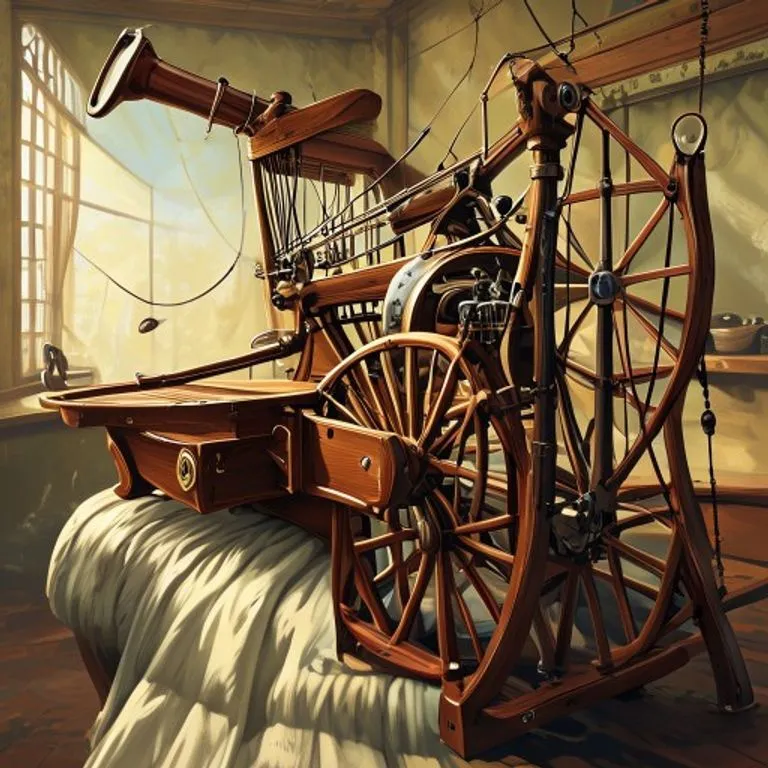
Brief description
The spinning jenny is a multi-spindle spinning frame that significantly increased the production of yarn by allowing a single worker to spin multiple spools of thread simultaneously. It was one of the key developments in the industrialization of textile manufacturing.
Use / Function
- Mass production of yarn: Allowed a single operator to work eight or more spools at once.
- Efficiency: Drastically reduced the amount of work needed to produce cloth.
- Home and Factory use: Initially small enough for cottage industries, it paved the way for larger industrial machines.
- Scale: Household to industrial.
Operating principle
The spinning jenny works by mimicking the motions of a hand spinner but on a larger, mechanical scale.
- Multiple Spindles: Unlike the spinning wheel which has one spindle, the jenny has several vertical spindles.
- Drawing out: A moving carriage draws out the rovings (loose bundles of fiber) to the required thinness.
- Twisting: As the carriage moves and the spindles spin, the fibers are twisted into yarn.
- Winding: When the carriage returns, the newly spun yarn is wound onto the bobbins.
How to create it
- Frame: Build a sturdy rectangular frame of Wood.
- Spindles: Install a row of vertical metal spindles at one end of the frame.
- Carriage: Create a sliding wooden frame (the carriage) that moves back and forth along the top of the main frame.
- Clamps: Install a set of wooden clamps (the “clove”) on the carriage to hold the rovings.
- Drive Mechanism: Use a large wheel connected by belts or cords to all the spindles, so they spin in unison when the wheel is turned.
- Operation: The weaver pulls the carriage back to stretch the fibers, turns the wheel to twist them, and then pushes the carriage forward to wind the finished yarn.
Materials needed
- Structure: Hard Wood for the frame and carriage.
- Spindles: Iron or steel rods.
- Drive: Plant fibers or leather for the drive cords and belts.
- Bearings: Metal or smooth wood for the moving parts.
Variants and improvements
- Spinning Wheel: The manual predecessor with a single spindle.
- Water Frame: A later invention that used water power and produced stronger yarn.
- Spinning Mule: A hybrid of the jenny and the water frame, combining the best features of both.
Limits and risks
- Yarn Strength: Early jennies produced yarn that was somewhat weak and suitable only for the weft (transverse threads), not the warp (longitudinal threads).
- Complexity: Requires precise tensioning of multiple cords to ensure all spindles spin correctly.
- Social Impact: Its introduction led to significant social unrest as it replaced the labor of many manual spinners.