Generated with AI3 min read
Jacquard Loom
Brief description
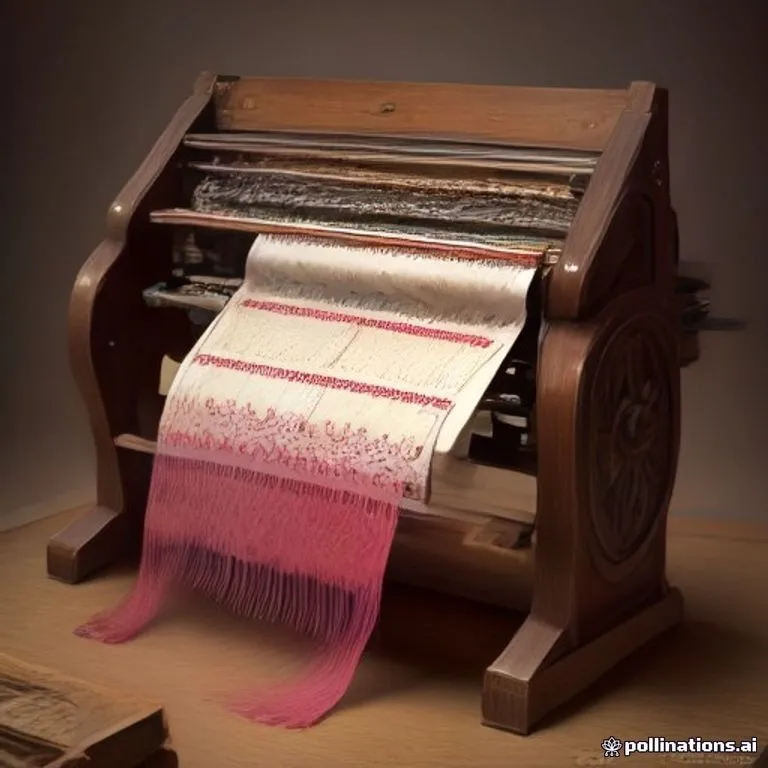
The Jacquard loom is a mechanical loom that uses a chain of punched cardboard cards to control the weaving of intricate patterns automatically. Invented by Joseph Marie Jacquard in 1804, it revolutionized textile manufacturing and introduced the concept of programmable hardware using punched cards.
Use / Function
- Automated Patterned Weaving: Enables the complex weaving of damask, brocade, tapestry, and figured fabrics without manual thread lifting.
- Mass Production of Textiles: Drastically reduced the time and labor required to produce elaborate textiles.
- Early Programmable Computing: Served as a direct technological predecessor to punched-card computing systems, analytical engines, and early digital computers.
Operating principle
- Punched Card Program: A series of heavy cardboard cards are punched with holes corresponding to the desired design pattern and linked together into a continuous loop.
- Needle Sensing Mechanism: As each card is pressed against a matrix of spring-loaded needles, needles that encounter a hole pass through, while solid areas push needles back.
- Hook and Harness Lifting: Needles that pass through holes allow attached vertical hooks (and thereby individual warp threads) to be lifted by an overhead frame (griffe).
- Shedding & Shuttle Pass: Lifting specific warp threads creates a custom shed through which the shuttle passes the weft thread.
- Card Advance: The card mechanism rotates to present the next punched card for the next row of weaving.
How to create it
- Base Frame: Assemble a heavy structural frame from Wood capable of supporting overhead mechanical harnesses and tensioned warp threads.
- Card Chain: Cut stiff Paper or cardboard sheets, punch pattern holes according to a grid design, and bind the cards into an endless chain using cordage.
- Prism & Needle Box: Mount a rotating wooden square prism to carry cards sequentially against a matrix of horizontal Iron sensing needles.
- Hooks and Griffes: Position vertical iron wire hooks connected to the needles, supported by a reciprocating overhead wooden frame (griffe) that lifts selected hooks.
- Harness Attachment: Connect harness cords from each hook down through a comber board to individual warp threads on the loom.
Materials needed
- Frame & Support: Wood (hardwood for precision frames and prisms).
- Sensing Mechanism & Hooks: Iron or steel wire.
- Pattern Cards: Heavy cardstock or stiff Paper.
- Harness & Binding: Strong cordage or thread, and woven Fabric tapes.
Variants and improvements
- Drawloom: The manual predecessor requiring a second operator (drawboy) to physically pull warp cords.
- Dobby Loom: A simplified mechanical loom for smaller geometric patterns using peg chains instead of full punched cards.
- Electronic Jacquard Loom: Modern computerized looms replacing physical punched cards with digital solenoids and microprocessors.
Limits and risks
- Mechanical Complexity: Requires precise alignment between punched holes, needles, and overhead hooks.
- Card Wear: Cardboard cards can wear out, expand with humidity, or tear, causing pattern glitches.
- Preparation Overhead: Creating and punching hundreds or thousands of cards for a new complex pattern requires substantial initial effort.