Generated with AI3 min read
Hygrometer
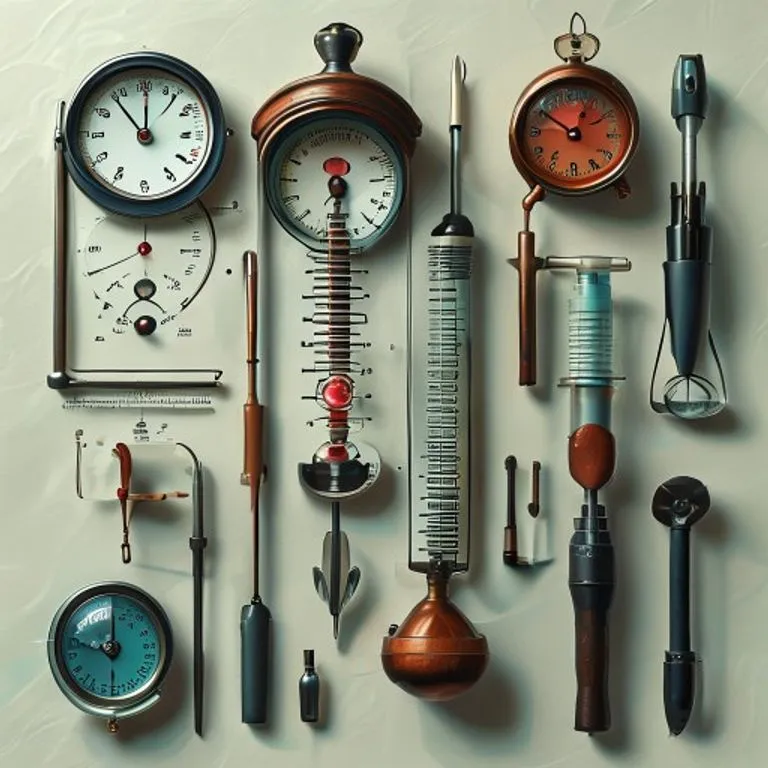
Brief description
A hygrometer is an instrument used to measure the amount of water vapor in the air, in soil, or in confined spaces. Humidity measurement instruments usually rely on measurements of some other quantity such as temperature, pressure, mass, or a mechanical or electrical change in a substance as moisture is absorbed.
Use / Function
- Primary use: Measuring relative humidity in the atmosphere for weather forecasting.
- Secondary uses: Monitoring humidity in greenhouses, museums, industrial processes, and cigar humidors.
- Scale: Personal, scientific, and industrial monitoring.
Operating principle
Hygrometers use various principles depending on their design:
- Hair Tension: Human or animal hair stretches or shrinks depending on humidity. This mechanical movement is linked to a needle on a scale.
- Psychrometer: Uses two thermometers, one dry and one wet (wrapped in a moist cloth). The cooling effect of evaporation on the wet bulb depends on the humidity of the air. The difference in temperature between the two thermometers allows humidity to be calculated.
- Absorption: Substances like certain salts change mass or electrical resistance as they absorb water from the air.
How to create it
- Hair Hygrometer (Simplest mechanical version):
- Secure one end of a long, degreased hair (human hair or Animal Hair).
- Wrap the hair around a small axle that holds a pointer.
- Attach a small weight to the other end of the hair to keep it under tension.
- As humidity changes, the hair length changes, rotating the axle and moving the pointer.
- Technical level: Basic to Intermediate.
Materials needed
- Essential: Animal Hair or human hair (must be cleaned with alcohol or ether to remove oils), Wood or Metal for the frame and scale, and a small weight.
- Tools: Scissors, glue, basic assembly tools.
- Possible substitutes: Certain synthetic fibers or biological membranes can also react to humidity.
Variants and improvements
- Saussure’s Hair Hygrometer: The classic 18th-century design.
- Sling Psychrometer: A psychrometer that is whirled in the air to ensure a consistent airflow over the wet bulb.
- Dew Point Hygrometer: Measures the temperature at which dew begins to form on a polished surface.
- Electronic/Digital Hygrometer: Uses capacitive or resistive sensors for high precision and data logging.
Limits and risks
- Calibration: Mechanical hygrometers require regular calibration against a known standard (like the psychrometer method).
- Contamination: Dust or oils on the hair can affect accuracy.
- Extreme Conditions: Very high or very low humidity can sometimes permanently deform the measuring element in mechanical versions.