Hydraulic Press
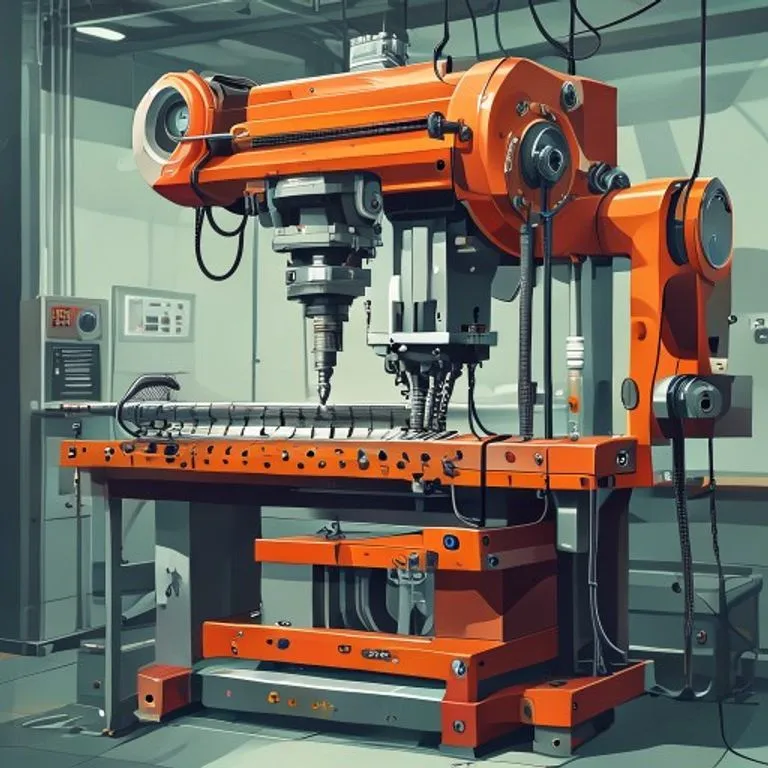
Brief description
A hydraulic press is a machine press using a hydraulic cylinder to generate a compressive force. It uses the hydraulic equivalent of a mechanical lever, allowing a small force applied to a small-diameter plunger to be transformed into a much larger force on a larger-diameter piston.
Use / Function
- Metalworking: Forging, clinching, moulding, blanking, punching, deep drawing, and metal forming operations.
- Crushing: Compacting waste, extracting oils from seeds, or crushing materials for testing.
- Construction: Testing the strength of concrete or other building materials.
- Assembly: Pressing bearings, gears, or pulleys onto shafts.
Operating principle
The hydraulic press is based on Pascal’s Principle: pressure exerted anywhere in a confined incompressible fluid is transmitted equally in all directions throughout the fluid.
- System: Two cylinders of different diameters connected together and filled with a fluid (water or oil).
- Input: A small force is applied to a small area (the pump piston).
- Pressure: This creates a pressure ($P = F/A$) in the fluid.
- Output: This same pressure acts on the larger area of the second piston (the ram). Since the area is larger, the resulting force ($F = P \times A$) is much greater.
- Trade-off: Like a lever, what is gained in force is lost in distance. The small piston must travel much further than the large piston.
How to create it
1. The Cylinders
Cast or machine two cylinders. The Iron or Steel walls must be thick enough to withstand high pressure without bursting. The inner surface must be very smooth.
2. The Pistons
Create two pistons that fit snugly into the cylinders.
3. The Seals (Crucial)
The pistons must be leak-proof. Traditional presses used Leather “U-cup” seals that expand under pressure to seal against the cylinder walls. Modern ones use synthetic rubber.
4. The Fluid
Use Water (cheap, but causes rust) or Vegetable Oil (lubricates and prevents rust).
5. The Frame
A heavy-duty frame made of Steel beams is required to contain the massive forces generated between the ram and the base.
Materials needed
- Iron or Steel: For the cylinders, pistons, and heavy frame.
- Leather: For high-pressure seals.
- Water or Vegetable Oil: As the hydraulic medium.
- Pipes and Valves: To connect the cylinders and control fluid flow.
Variants and improvements
- Bramah Press: The original 1795 design using leather seals.
- Arbor Press: A manual version using gears instead of hydraulics for lighter tasks.
- Forging Press: Massive industrial presses used to shape hot steel ingots.
Limits and risks
- Pressure Failure: If a cylinder or pipe bursts under pressure, it can be extremely dangerous.
- Leakage: Even small leaks significantly reduce efficiency and can be messy.
- Speed: Hydraulic presses are generally slower than mechanical presses but can apply much more sustained force.
Related Inventions
- Lever (Mechanical equivalent)
- Pump (To provide the input fluid)
- Valve (To control the direction of the fluid)
- Pipes