Generated with AI3 min read
Difference Engine
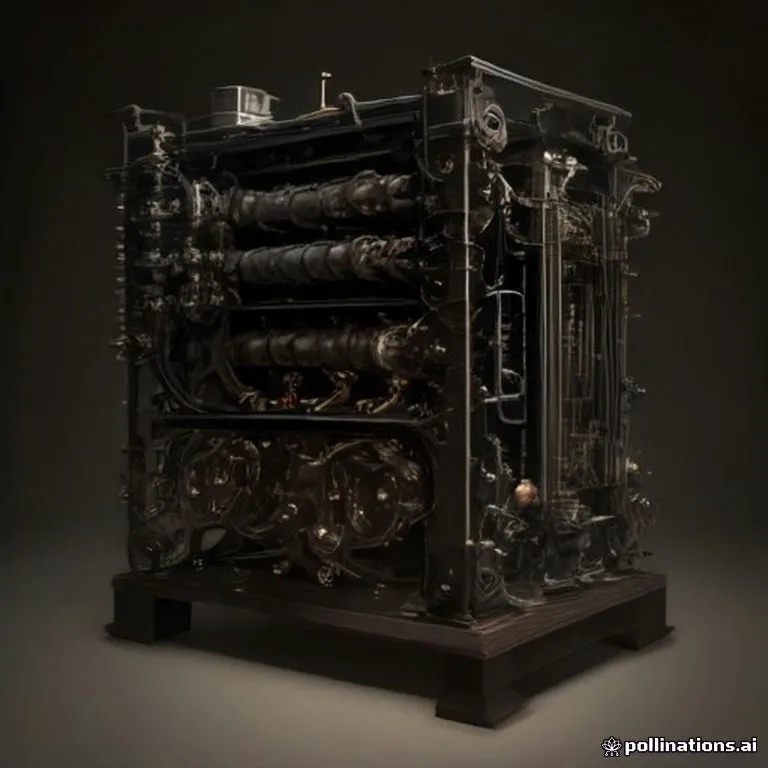
Brief description
An automatic mechanical calculator designed to tabulate polynomial functions. Created to eliminate human error in mathematical tables used for navigation, engineering, and astronomy, the Difference Engine uses the method of divided differences to perform complex calculations using only addition.
Use / Function
- Primary use: Generating accurate mathematical, astronomical, and navigational tables (such as logarithmic and trigonometric tables).
- Secondary uses: Automated error-free printing of computed data onto metal or paper plates.
- Scale: Large precision machine intended for institutional or central state usage.
Operating principle
- Method of Differences: Any polynomial function can be computed purely using repetitive addition if high-order constant differences are calculated first.
- Columnar Digit Representation: Numbers are represented by stacks of toothed brass wheels, where each wheel position corresponds to a digit (0–9).
- Addition and Carry Mechanism: Turning a main shaft engages gears that add the values from one column to another. When a wheel transitions from 9 to 0, a mechanical carry lever trips the adjacent wheel of higher significance.
- Mechanical Automation: Hand-cranked or steam-driven rotation of the central driveshaft cycles through addition and carry phases sequentially across all columns.
How to create it
- Fabricate Toothed Gears and Columns: Machining identical gear wheels with ten distinct tooth positions and precise detents to prevent backlash.
- Assemble Carry Mechanisms: Installing carry levers and warning trips between digit positions to handle multi-digit arithmetic smoothly.
- Build the Drive Shaft and Cam Assembly: Constructing a central timing shaft with cams that lift and rotate specific gear stacks in sequence (Addition phase followed by Carry phase).
- Integrate the Printing Mechanism: Linking output columns to a stamping head that presses calculated values directly into soft metal or papier-mâché molds for stereotype printing.
Materials needed
- Gears and Digit Wheels: Brass (easy to machine and low friction).
- Axles, Levers, and Frame: Steel and Iron (high structural stability and wear resistance).
- Base and Support Columns: Cast Iron.
Variants and improvements
- Difference Engine No. 1 (Babbage): The initial design by Charles Babbage, partially constructed in the 1820s-1830s.
- Scheutzian Calculation Engine: Built by Per Georg Scheutz in the 1850s, a working compact version that produced printed tables.
- Difference Engine No. 2: Babbage’s refined design requiring fewer parts, successfully built by the Science Museum in London in 1991.
- Analytical Engine: The general-purpose programmable successor using punched cards and memory.
Limits and risks
- Precision Manufacturing Tolerances: Requires extremely precise machining; cumulative friction and backlash can jam the mechanism if parts are not manufactured to tight tolerances.
- Mechanical Wear: High tooth count and repetitive impact during carry operations require constant lubrication and maintenance.
- Complexity and Cost: High component count makes construction expensive and time-consuming.