Generated with AI3 min read
Crank and Cam
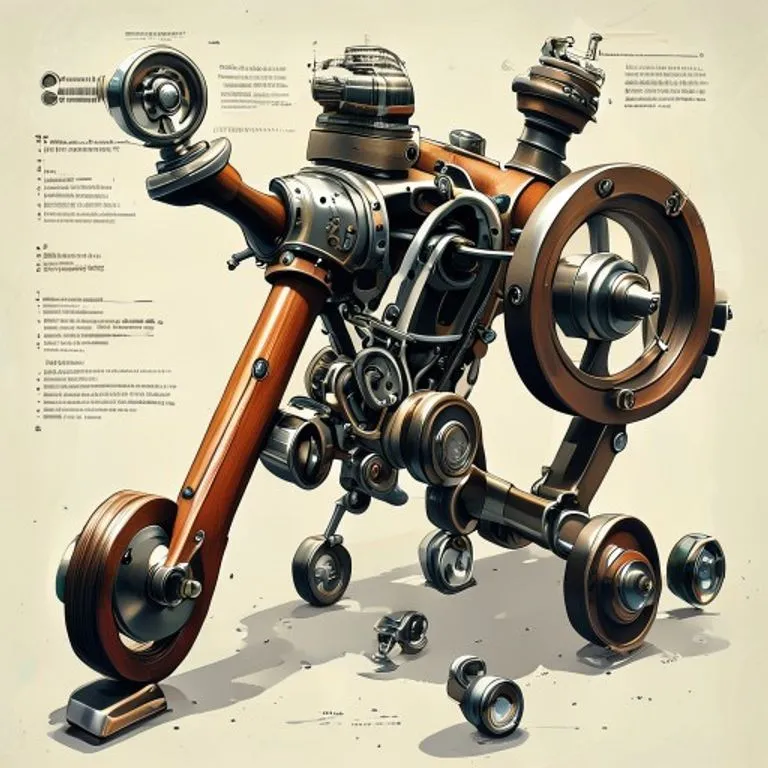
Brief description
The crank and the cam are essential mechanical links used to transform motion, typically converting rotary motion into reciprocating linear motion or vice versa. They are fundamental components in complex machinery, from ancient watermills to modern internal combustion engines.
Use / Function
- Motion Transformation: Converting rotation (from a wheel or shaft) into a back-and-forth movement (for a saw, pump, or piston).
- Timing Control: Cams allow for precise timing of movements (like opening and closing valves).
- Power Transmission: Cranks allow humans or engines to apply torque to a rotating shaft through linear force.
Operating principle
- Crank: Consists of an arm attached at right angles to a rotating shaft. When a connecting rod is attached to the arm, the circular path of the crank pulls and pushes the rod in a reciprocating motion.
- Cam: A rotating or sliding piece (the cam) with a non-circular profile that strikes a follower at one or more points of its motion. The shape of the cam determines the specific movement profile of the follower.
How to create it
Simple Wooden Crank
- Shaft: A sturdy wooden axle.
- Arm: A perpendicular piece of wood firmly attached to the end of the shaft.
- Handle/Rod: A pin or handle at the outer end of the arm to provide leverage or connect to a rod.
Simple Cam
- Disk: A circular disk of wood or metal.
- Offsetting: Mount the disk off-center on a shaft, or carve it into an oval/pear shape.
- Follower: A rod that rests against the edge of the cam, guided so it can only move linearly.
Materials needed
- Structural: Wood (hardwood), Iron, or Steel for durability.
- Lubricant: Animal fat or grease to reduce friction between the cam and follower.
Variants and improvements
- Crankshaft: A shaft with multiple cranks integrated into it, used in multi-cylinder engines.
- Eccentric: A variation of the crank where a circular disk is mounted off-center on a shaft, often used to drive valves.
- Camshaft: A shaft with multiple cams, used to synchronize multiple actions (like valve timing).
Limits and risks
- Friction and Wear: Cams, especially, are subject to high friction at the contact point with the follower. Constant lubrication is required.
- Stress: The joint between the crank arm and the shaft is a common point of mechanical failure under high torque.
- Balance: High-speed cranks and cams can cause significant vibration if not properly counterbalanced.