Generated with AI3 min read
Calorimeter
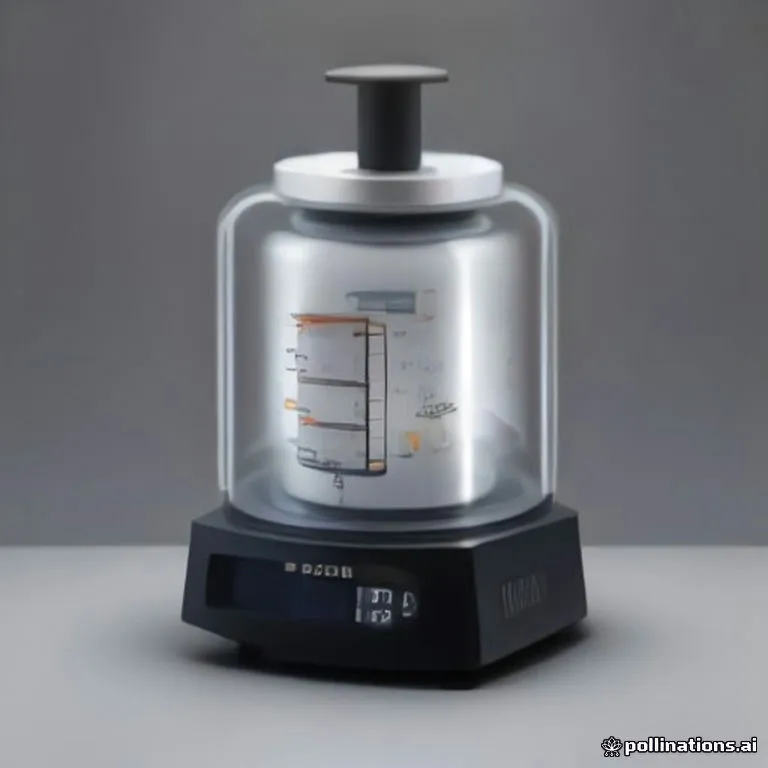
Brief description
A calorimeter is a thermal measurement apparatus designed to measure the amount of heat released or absorbed during chemical reactions, phase transitions, or physical changes. By capturing heat within an insulated container and monitoring the resulting temperature change in a working liquid, it allows precise determination of specific heat capacities and fuel energy values.
Use / Function
- Fuel Energy Analysis: Determining the caloric energy density and combustion efficiency of biomass, coal, oils, and gases.
- Specific Heat Determination: Measuring the heat storage capacity of various metals, minerals, and construction materials.
- Reaction Enthalpy: Quantifying heat release or absorption in chemical synthesis, neutralization reactions, and fermentation.
Operating principle
- Thermal Isolation: A vessel containing a measured quantity of water is thermally isolated from its ambient environment using low-conductivity insulating materials and reflective barriers.
- Heat Exchange: A hot object, chemical reaction, or combustion event inside the inner vessel transfers thermal energy directly to the surrounding water and vessel walls.
- Calorimetric Equation: Assuming minimal heat loss to the outside, heat gained by the liquid equals heat lost by the source ($Q = mc\Delta T$). By knowing the mass and specific heat of water and the container, the unknown energy release is calculated.
How to create it
- Form Inner Vessel: Fabricate a thin-walled inner canister out of high thermal conductivity metal like polished copper to ensure rapid thermal equilibrium.
- Prepare Outer Jacket: Construct a larger outer container made of wood, brass, or sheet metal to act as an environmental protective shield.
- Install Thermal Insulation: Line the space between the inner and outer vessels with dry wool, cork, or felt, supporting the inner vessel on non-conducting cork or wooden pegs.
- Fabricate Insulated Lid: Create a close-fitting wooden or cork lid with two small holes: one for a sensitive thermometer and one for a wire stirrer.
- Assemble Stirrer & Thermometer: Fit a looped copper wire stirrer to ensure uniform liquid temperature without introducing excess friction heat, and suspend a liquid-in-glass thermometer into the water.
Materials needed
- Essential: Polished Copper sheet, distilled Water, Wood block, unspun Wool or cork for insulation.
- Tools: Sheet metal shears, soldering iron, sensitive liquid-in-glass thermometer, accurate balance scale.
- Substitutes: Glass jar or tin can can serve as the inner vessel; wood shavings or cotton can replace wool insulation.
Variants and improvements
- Coffee-Cup Calorimeter: A simple constant-pressure calorimeter made of nested polystyrene foam cups, ideal for solution-phase reactions.
- Bomb Calorimeter: A high-pressure, oxygen-charged steel reaction chamber submerged in water to measure constant-volume combustion heats of solid fuels.
- Ice Calorimeter (Lavoisier-Laplace): Measures heat absorbed by determining the exact mass of ice melted into liquid water, eliminating temperature measurement errors.
Limits and risks
- Heat Leakage: Incomplete insulation causes thermal leakage to or from the surrounding room, introducing systematic calculation errors.
- Incomplete Combustion: Open calorimetry can suffer from soot formation or incomplete burning, resulting in underreported fuel values.
- Overpressure Hazard: Bomb calorimeters operate under substantial oxygen pressure and present severe burst hazards if overcharged.