Generated with AI3 min read
Truss
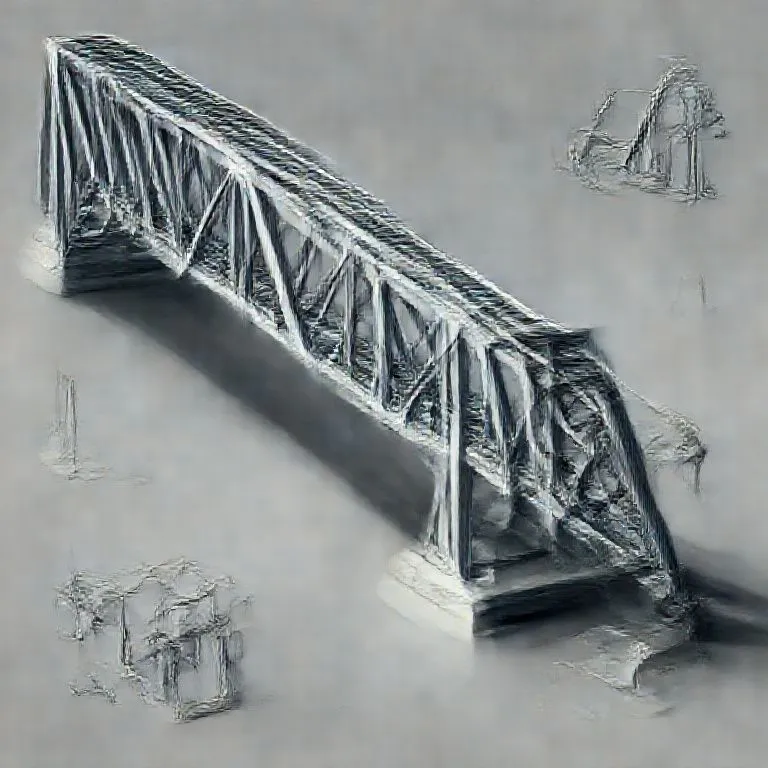
Brief description
A structural framework composed of straight members connected at joints, typically forming triangles. It is designed to support loads over a span while using significantly less material than a solid beam.
Use / Function
- Bridges: Allows for long spans with lightweight structures.
- Roofs: Supports the weight of roofs in houses, barns, and large halls.
- Cranes and Towers: Provides high strength-to-weight ratio for vertical structures.
- Scale: From small house roof rafters to massive railway bridges.
Operating principle
The truss works through the geometric stability of the triangle.
- A triangle is the only polygon that is inherently rigid; its shape cannot be changed without changing the length of its sides.
- Loads applied at the joints are converted into tension (pulling) or compression (pushing) forces along the members.
- Because the members only deal with axial forces (tension/compression) rather than bending, they can be much thinner and lighter than a solid beam.
How to create it
- Design: Choose a truss pattern (e.g., King Post, Pratt, Warren) based on the span and load.
- Preparation: Cut members (wood beams or metal bars) to precise lengths.
- Joints: Connect members at the nodes.
- Wood: Use bolts, gusset plates, or traditional joinery (mortise and tenon).
- Metal: Use welding, rivets, or bolts.
- Assembly: Build the triangles one by one, ensuring all joints are secure.
- Installation: Lift the truss into place and secure it to the supports.
Materials needed
- Essential:
- Wood: Hardwood or softwood depending on the load.
- Steel/Iron: For high-strength industrial applications.
- Fasteners: Bolts, nails, rivets, or welding rods.
- Tools: Saws, drills, wrenches, welding equipment (if metal), levels.
Variants and improvements
- King Post: Simple triangle with a central vertical post.
- Pratt Truss: Vertical members are in compression, diagonals in tension.
- Warren Truss: Uses equilateral triangles (alternating diagonals).
- Space Frame: A 3D truss that can span large areas in two directions.
Limits and risks
- Buckling: Long members in compression can bend or snap if they are too thin.
- Joint Failure: The joints are the weakest points; if a bolt shears or a weld cracks, the whole structure can collapse.
- Corrosion: Rust in metal trusses or rot in wooden ones can compromise structural integrity.
- Improper Loading: Trusses are designed for loads at the joints; hanging heavy weights from the middle of a member can cause failure.