Generated with AI2 min read
Spectroscope
Made of
Brief description
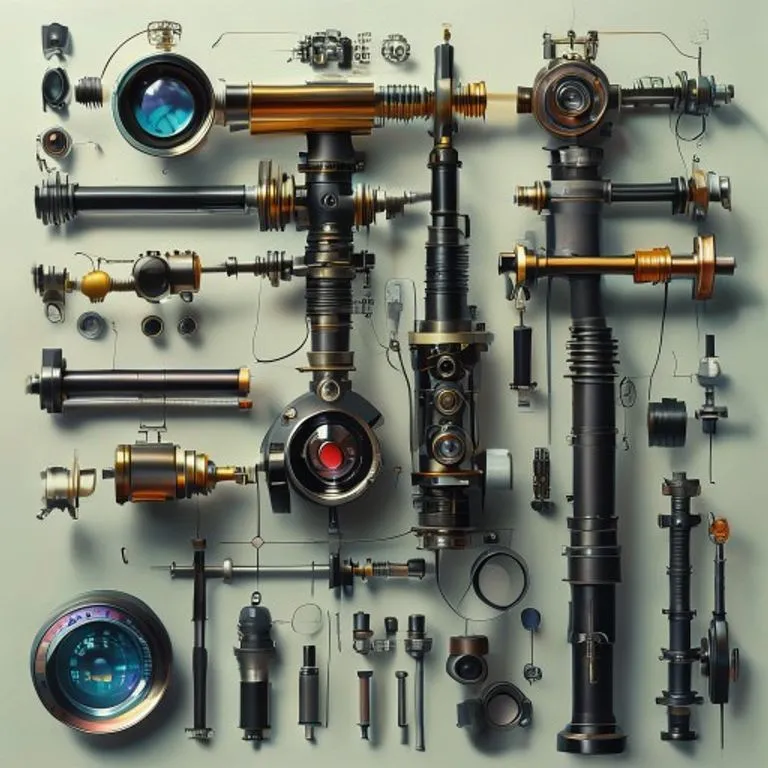
A spectroscope is an instrument used to split light into its component colors (a spectrum). It allows for the chemical analysis of substances by observing the unique patterns of light they emit or absorb.
Use / Function
- Chemical Analysis: Identifying elements in a flame (flame test).
- Astronomy: Determining the composition, temperature, and motion of stars.
- Mineralogy: Identifying gemstones and minerals.
- Scale: Laboratory tool.
Operating principle
The spectroscope works via dispersion or diffraction:
- Light enters through a narrow slit, ensuring a sharp image.
- The light passes through a dispersing element (a Glass prism or a diffraction grating).
- Different wavelengths (colors) of light are bent at different angles.
- The resulting spectrum is viewed through an eyepiece or projected onto a surface.
How to create it
Minimum functional version
- Tube: A dark, light-tight tube made of Paper (cardboard) or Metal.
- Slit: At one end, place two sharp, straight edges (like Knife blades or blackened foil) very close together to form a tiny slit.
- Dispersing Element: At the other end, place a Glass prism.
- Viewing: Look through the prism at the slit while pointing the slit toward a light source.
Materials needed
- Essential materials:
- Tools:
- Knife or shears.
- Means of producing a narrow, straight slit.
Variants and improvements
- Diffraction Grating Spectroscope: Uses a surface with thousands of tiny parallel lines instead of a prism; provides more linear dispersion.
- Spectrometer: Includes a calibrated scale (like a Protractor) to measure the exact angles of light deflection.
- Spectrograph: Uses a camera to record the spectrum on film or a sensor.
Limits and risks
- Light Intensity: Requires a sufficiently bright light source to see the spectrum clearly.
- Alignment: Very sensitive to the alignment of the slit and the prism.
- Optical Quality: Imperfections in the glass or water will distort the spectrum.
- Eye Safety: Never look directly at the sun through a spectroscope without professional solar filters.