Generated with AI2 min read
Pottery
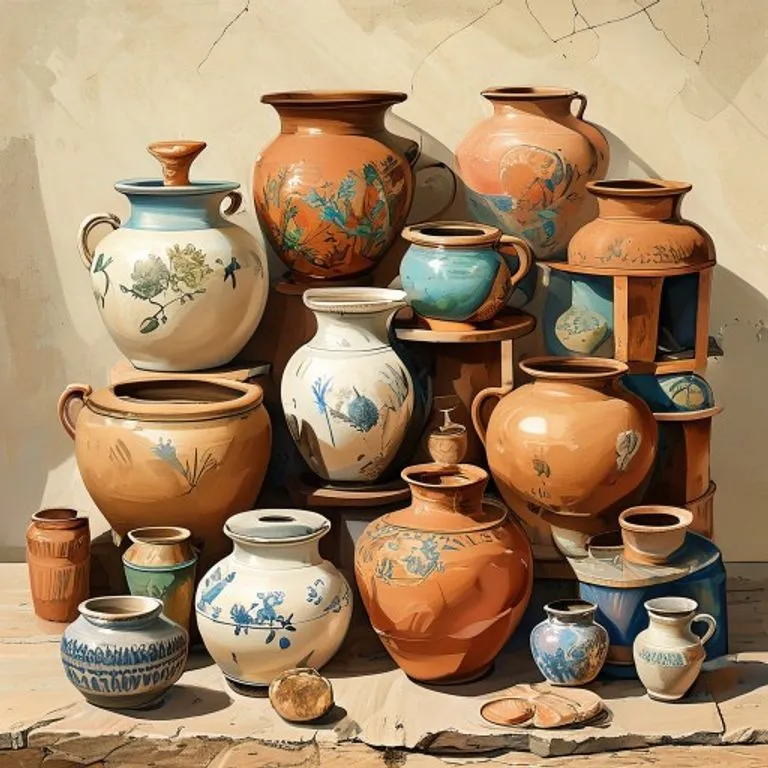
Brief description
Pottery is the art and technology of making objects from shaped clay that is then hardened by the application of heat at high temperatures.
Use / Function
- Storage: Vessels for grain, water, or oil.
- Cooking: Fire-resistant pots and plates.
- Lighting: Oil lamps.
- Construction: Bricks, tiles, and floor tiles.
- Sanitation: Pipes and conduits.
Operating principle
Clay contains chemically bound water. When heated above 600°C, it loses this water and undergoes an irreversible transformation called sintering, where particles fuse partially creating a solid, rigid, and durable structure.
How to create it
- Preparation: Mix clay with water until a malleable mass is obtained.
- Shaping: Shape by hand, by coils, or using a potter’s wheel.
- Drying: Let water evaporate at room temperature to avoid cracks.
- Firing: Heat in a kiln or pit at high temperatures (800°C - 1200°C).
Materials needed
- Clay: Clayey soil rich in silicates.
- Water: For plasticity.
- Temper: Sand or chopped straw to reduce shrinkage during drying.
- Fuel: Wood or charcoal for the kiln.
Variants and improvements
- Terracotta: Porous pottery fired at low temperature.
- Stoneware: Denser and stronger, fired at higher temperature.
- Porcelain: White and translucent, high quality.
- Glazing: Application of a glassy layer to make it completely waterproof.
Limits and risks
- Brittleness: Breaks easily on impact or falls.
- Thermal shock: Sudden temperature changes can crack it.
- Contamination: Some old glazes contained lead.
Related inventions
- Potter’s Wheel: Machine for shaping round vessels.
- Kiln: Oven for firing pottery.
- Firing: The essential process.