Generated with AI3 min read
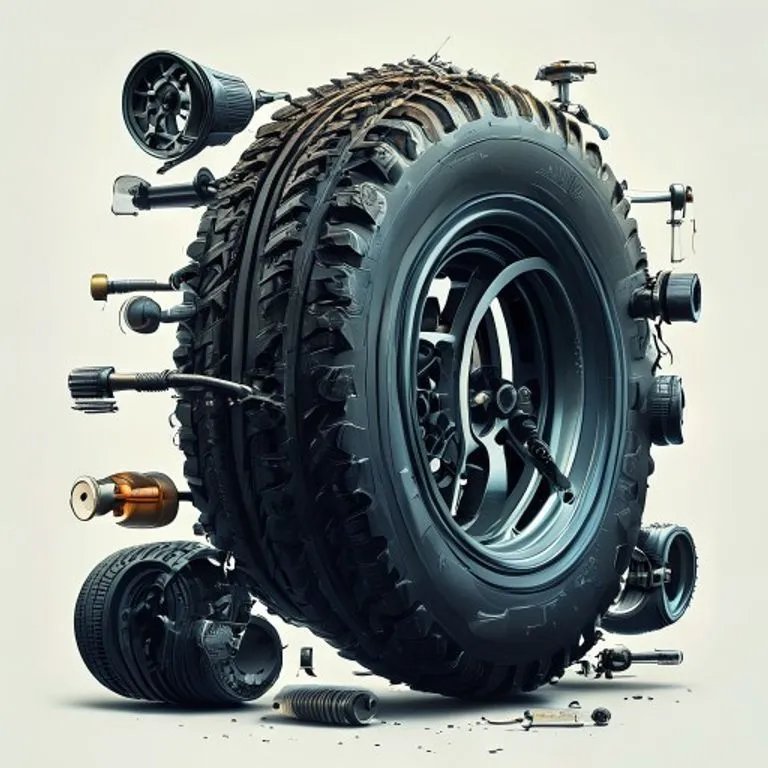
Pneumatic Tire
Made of
Brief description
A pneumatic tire is a flexible, air-filled ring that surrounds a wheel’s rim. It provides traction, absorbs shocks from uneven terrain, and protects the wheel from wear. It revolutionized transportation by making vehicles faster, more efficient, and more comfortable.
Use / Function
- Transportation: Essential for bicycles, cars, trucks, and aircraft.
- Shock Absorption: Acts as a primary suspension component by cushioning impacts.
- Traction: Provides a high-friction interface between the vehicle and the road.
- Scale: From small bicycle tires to massive mining truck tires.
Operating principle
The tire works on the principle of a pressurized container:
- Containment: A strong, flexible casing (made of rubber and fabric) holds compressed air.
- Deformation: The air pressure allows the tire to deform slightly when it hits a bump, spreading the force over a larger area.
- Recovery: The compressed air pushes back, returning the tire to its shape and providing a “spring” effect.
- Friction: The rubber tread provides grip through molecular adhesion and mechanical interlocking with the road surface.
How to create it
Creating a durable pneumatic tire requires advanced materials and processes:
- Casing Construction: Layers of Fabric (traditionally canvas or nylon) are coated with rubber to form the “carcass” or “plies.”
- Bead Formation: Steel Wire is used to create “beads” that hold the tire firmly against the wheel rim.
- Tread Application: A thicker layer of tough, abrasion-resistant rubber is applied to the outer circumference.
- Vulcanization: The entire assembly is placed in a mold and heated with sulfur (Vulcanization) to chemically bond the layers and give the rubber its final properties.
- Inflation: The tire is mounted on a rim and filled with compressed air via a Valve.
Materials needed
- Elastic Base: Natural Rubber (or synthetic rubber).
- Reinforcement: Fabric (cotton, silk, or synthetic fibers).
- Structural Integrity: Wire (steel) for the beads.
- Chemicals: Sulfur for vulcanization.
- Inflation: Compressed air.
Variants and improvements
- Solid Rubber Tire: Durable but lacks the shock absorption of pneumatic tires.
- Inner Tube System: A separate air-tight tube inside a protective outer casing (standard for many years).
- Tubeless Tire: The tire itself forms an air-tight seal with the rim; more resistant to blowouts.
- Radial vs. Bias-ply: Different ways of arranging the fabric layers for better handling or durability.
Limits and risks
- Punctures: Sharp objects can cause the air to leak, rendering the tire flat.
- Blowouts: Sudden loss of pressure at high speeds can lead to loss of vehicle control.
- Degradation: Rubber perishes over time when exposed to UV light and ozone.
- Pressure Sensitivity: Over-inflated or under-inflated tires have reduced performance and higher wear.