Generated with AI3 min read
Photography
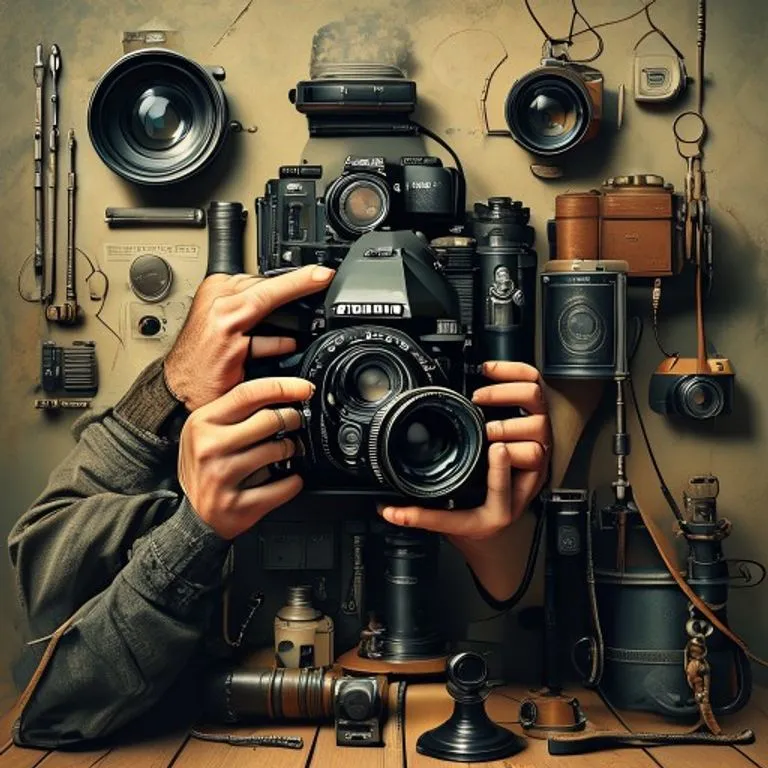
Brief description
Photography is the art and science of capturing durable images by recording light, either chemically by means of a light-sensitive material or electronically by means of an image sensor. It allows for the objective preservation of visual information.
Use / Function
- Documentation: Recording historical events, scientific data, and personal memories.
- Surveillance: Monitoring areas for security or research.
- Astronomy: Capturing light from distant celestial bodies over long exposures.
- Communication: Visual storytelling and news reporting.
Operating principle
Photography relies on two main components: the Camera Obscura (a dark chamber that projects an image) and a light-sensitive chemical reaction.
- Projection: Light from a scene passes through a small hole or Lens, projecting an inverted image onto a surface.
- Capture: This surface is coated with light-sensitive chemicals (typically silver halides). When light hits these chemicals, it causes a microscopic change (the latent image).
- Development: Chemicals are used to amplify this change into a visible image.
- Fixing: A “fixer” chemical (like Salt or sodium thiosulfate) removes the unreacted light-sensitive chemicals so the image no longer reacts to light.
How to create it
1. The Camera
Construct a light-tight box. On one side, place a Lens (or a simple pinhole). On the opposite side, place a holder for the light-sensitive plate or paper.
2. The Light-Sensitive Surface (Daguerreotype-style)
- Take a highly polished Silver-plated copper sheet.
- Sensitize it by exposing it to iodine vapors (forming silver iodide).
3. Exposure
Place the plate in the camera and expose it to a bright scene for several minutes.
4. Development and Fixing
- Expose the plate to mercury vapors (dangerous) or use a “wet-plate” process with gallic acid or pyrogallol.
- Fix the image by washing the plate in a strong solution of Salt or sodium thiosulfate to make it permanent.
Materials needed
- Silver: Used to create light-sensitive silver salts.
- Nitric Acid: Used to dissolve silver to create silver nitrate.
- Glass: Used as a substrate for negatives (wet-plate) or for lenses.
- Salt: Can be used as a primitive fixing agent.
- Water: For washing and mixing chemical solutions.
Variants and improvements
- Pinhole Camera: The simplest form, using no lens.
- Wet-Plate Collodion: Used glass plates coated with chemicals; required the plate to be exposed and developed while still wet.
- Dry-Plate: Used gelatin-based coatings, allowing plates to be prepared in advance.
- Film: Flexible celluloid backing instead of glass or metal.
Limits and risks
- Chemical Toxicity: Many early photographic chemicals (mercury, cyanide, strong acids) are highly toxic.
- Light Sensitivity: Materials must be handled in near-total darkness or under “safelights” (red light) until fixed.
- Complexity: Requires precise timing and chemical purity to achieve clear results.
- Fragility: Glass plates and early films are fragile and can degrade over time.