Generated with AI2 min read
Camera Obscura
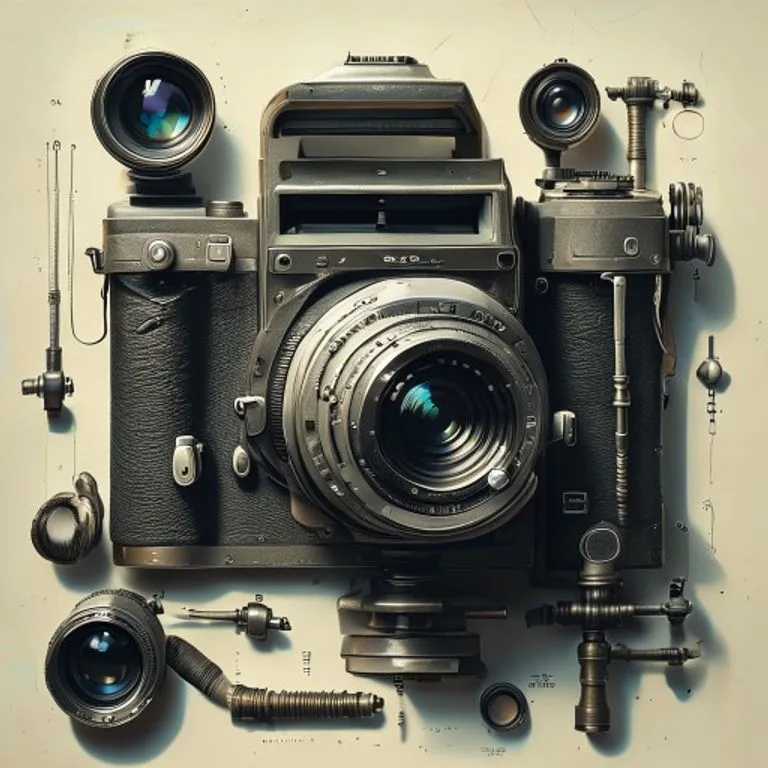
Brief description
A camera obscura (Latin for “dark room”) is an optical device that projects an image of its surroundings onto a screen. It is the fundamental principle behind the camera and photography.
Use / Function
- Drawing Aid: Allows artists to trace accurate perspectives and details from nature.
- Observation: Safe viewing of solar eclipses or distant landscapes.
- Entertainment: Large-scale camera obscuras were used as tourist attractions.
- Foundation of Photography: Provides the projected image that light-sensitive materials capture.
Operating principle
It exploits the fact that light travels in straight lines:
- Darkened Space: A room or box is made completely dark.
- Aperture: A small hole (pinhole) or Lens is placed on one side.
- Projection: Light from outside passes through the aperture and crosses, projecting an inverted and reversed image onto the opposite surface inside.
How to create it
Minimum functional version (Pinhole)
- Box: Take a light-tight box and paint the inside black.
- Hole: Make a very small, clean hole in the center of one side using a needle.
- Screen: Place a piece of white paper or translucent material (tracing paper) on the opposite side to view the image.
Technical level: Basic.
Materials needed
- Essential: A light-proof container (Wood, cardboard, or a darkened room) and a small aperture.
- Tools: Sharp needle or drill for the hole.
- Improvements: A convex Lens to brighten and sharpen the image; a Mirror to flip the image upright.
Variants and improvements
- Pinhole Camera Obscura: Simple but produces a dim image.
- Lens-based Camera Obscura: Uses a glass lens to gather more light, resulting in a much brighter and sharper projection.
- Portable Version: Small boxes with angled mirrors and frosted glass screens for artists to use in the field.
Limits and risks
- Image Brightness: Pinhole versions require very bright sunlight to be visible.
- Inversion: Without mirrors, the projected image is always upside down and backwards.
- Fixed Focus: Pinhole versions have infinite depth of field but low sharpness; lens versions require focusing by moving the screen or lens.