Hot Air Balloon
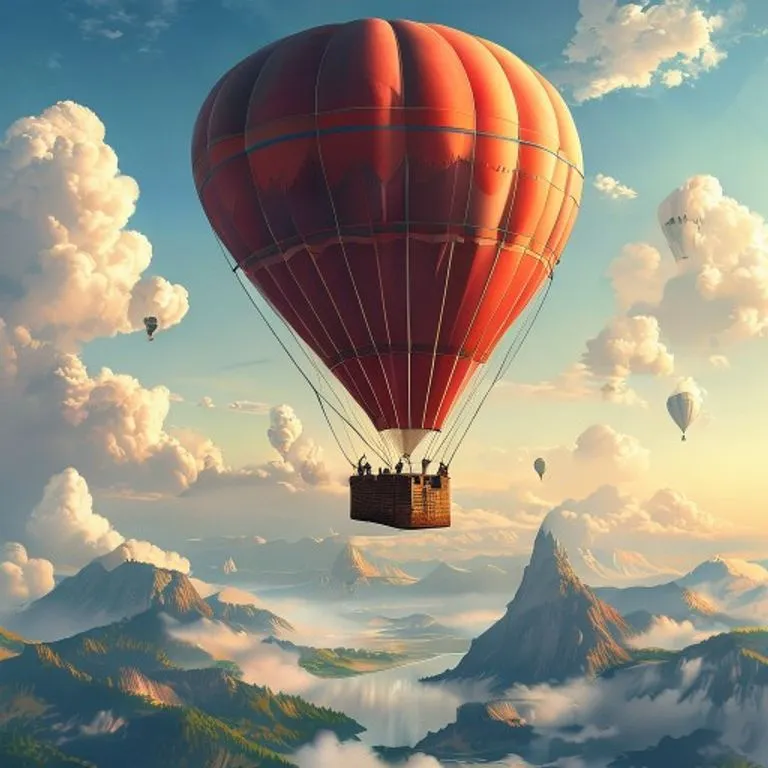
Brief description
A lighter-than-air aircraft consisting of a bag (envelope) containing heated air and a basket for passengers or cargo. It is the oldest successful human-carrying flight technology.
Use / Function
- Transportation: Observation and travel, although direction is dependent on wind currents.
- Scientific Research: Meteorological observations and high-altitude experiments.
- Surveillance: Military reconnaissance (historically).
- Scale: Can carry from one person to large groups.
Operating principle
The hot air balloon operates on the Archimedes’ Principle:
- Buoyancy: Hot air is less dense than the cooler surrounding air. This density difference creates an upward buoyant force.
- Lift: When the buoyant force exceeds the total weight of the balloon, basket, and payload, the balloon rises.
- Control: To descend, the air inside is allowed to cool or is released through a vent. To rise, more heat is added using a burner or fire.
- Direction: The balloon travels with the wind. Pilots can change altitude to find wind currents blowing in different directions.
How to create it
1. The Envelope
Construct a large, lightweight, and relatively airtight bag. Historically made of Silk or paper, often coated with Vegetable Oil or varnish to reduce permeability. Modern envelopes use heat-resistant nylon.
2. The Basket (Gondola)
A lightweight but sturdy container for the payload, typically woven from Wicker or bamboo to provide strength and flexibility for landings.
3. The Burner/Heat Source
In primitive versions, a fire grate was suspended below the opening. Modern versions use propane burners. The heat source must be powerful enough to keep the air inside the envelope significantly warmer than the outside air.
4. Rigging
High-strength Rope or cables connect the basket to the envelope, distributing the load across the structure.
Materials needed
- Silk, Canvas, or Paper: For the envelope.
- Vegetable Oil or Resin: For coating the fabric.
- Wicker or Bamboo: For the basket.
- Rope: For structural connections.
- Fuel: Wood, Coal, or Alcohol (for heat).
Variants and improvements
- Montgolfière: The original hot air design using smoke and hot air.
- Charlière: A balloon filled with hydrogen or helium (gas balloon) for much longer flight times.
- Rozier Balloon: A hybrid using both a heated gas cell and a non-heated lifting gas.
Limits and risks
- Wind Dependency: Little control over horizontal direction; depends entirely on wind currents.
- Fire Hazard: The proximity of a large heat source to flammable fabrics is a significant risk.
- Landing: Landings can be rough, especially in high winds, as the balloon cannot be easily stopped.
- Weather: Extremely sensitive to thermal activity and thunderstorms.