Generated with AI2 min read
Dam
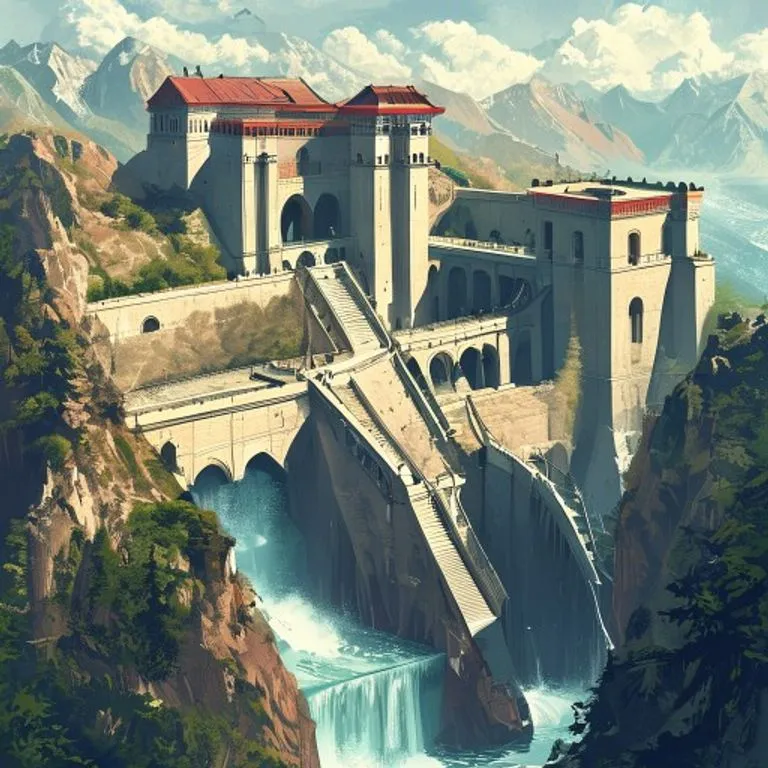
Brief description
A barrier constructed to hold back water and raise its level, forming a reservoir used for water storage, irrigation, or electricity generation.
Use / Function
- Primary use: Creating a reservoir for Water Supply during dry seasons.
- Secondary uses: Flood control, hydroelectric power, irrigation, recreation.
- Scale: Small (farm pond) to massive (Hoover Dam).
Operating principle
- Hydrostatic Pressure: The dam wall resists the immense pressure of the water behind it.
- Gravity: The weight of the dam itself anchors it against the water’s push (Gravity Dam).
- Arch Action: The curved shape transfers water pressure to the canyon walls (Arch Dam).
How to create it
- Site Selection: Narrow valley with solid bedrock foundation.
- Diversion: Temporarily divert the river (tunnels or channels) to work on a dry riverbed.
- Foundation: Excavate loose soil down to solid rock. Grout cracks to prevent seepage under the dam.
- Construction: Build the wall using concrete, stone masonry, or compacted earth.
- Spillway: Include a channel to safely release excess water during floods to prevent overtopping.
Materials needed
- Structure: Concrete, Stone, Earth (clay core), Timber (small dams).
- Waterproofing: Clay core, concrete face.
- Tools: Excavators (or shovels), cranes.
Variants and improvements
- Earthfill Dam: Embankment of compacted soil with a clay core. Cheapest, suitable for broad valleys.
- Gravity Dam: Massive concrete/stone wall. Requires strong foundation.
- Arch Dam: Thin, curved concrete wall. Requires strong canyon walls.
- Beaver Dam: Natural example using wood and mud.
Limits and risks
- Failure: Catastrophic flooding downstream if the dam breaks.
- Siltation: Sediment builds up behind the dam, reducing capacity over time.
- Ecosystem: Blocks fish migration and alters river ecology.
- Seepage: Water leaking under the dam can erode the foundation (piping).
Related inventions
- Water Supply: Beneficiary.
- Concrete: Key material.
- Watermill: Uses the head of water created.
- Canal: Distribution from the dam.