Generated with AI3 min read
Watermill
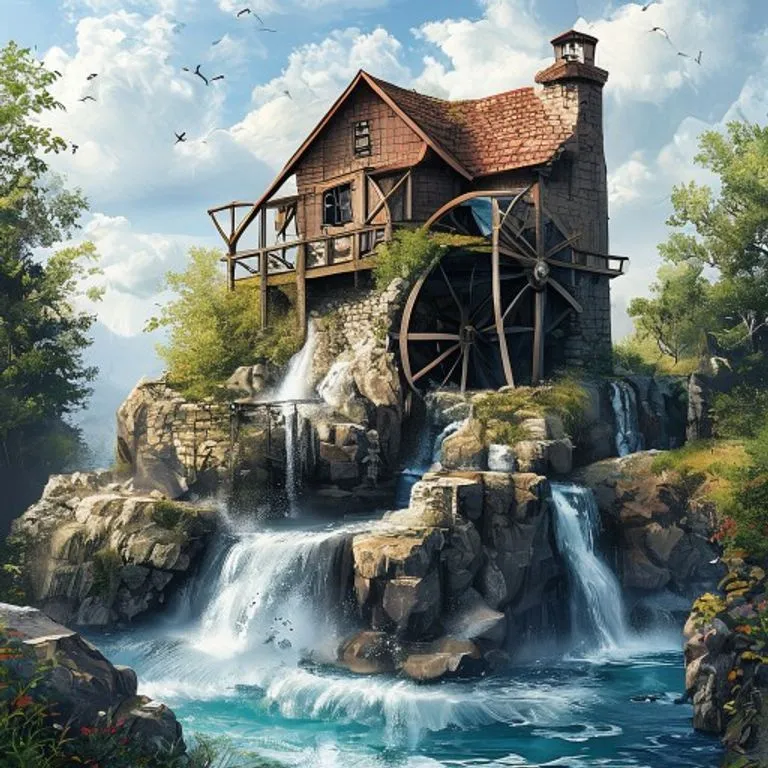
Made of
Brief description
A watermill is a structure that uses a water wheel or water turbine to drive a mechanical process such as milling (grinding), rolling, or hammering. Such processes are innovative for agriculture and manufacturing.
Use / Function
- Milling: Grinding grain into flour.
- Sawing: Powering large saws to cut lumber.
- Fulling: Pounding woolen cloth to clean and thicken it.
- Metalworking: Powering bellows and trip hammers in forges.
- Scale: Industrial/Local.
Operating principle
The mill harnesses the kinetic energy of flowing or falling water.
- Flow: Water is directed onto the blades or buckets of a water wheel.
- Rotation: The force of the water causes the wheel to rotate.
- Transmission: The rotating shaft of the water wheel is connected to gears that change the direction or speed of rotation.
- Work: The final gear or shaft drives the machinery (e.g., rotating the upper millstone).
How to create it
- Site selection: Find a source of flowing water with sufficient volume and drop (head).
- Water Wheel construction: Build a wheel with paddles (undershot) or buckets (overshot) made of durable wood or metal.
- Sluice/Millrace: Construct a channel to direct water from the source to the wheel.
- Drivetrain: Install a main shaft connected to the wheel and use bevel gears to transfer power to the vertical shaft of the mill.
- Millstones: Set up the fixed bedstone and the rotating runner stone.
- Control mechanism: Install a sluice gate to control the water flow and stop the mill.
Materials needed
- Water wheel and structure: Strong, water-resistant wood (like oak) or iron.
- Millstones: Hard, abrasive stone (granite, basalt).
- Shafts and Gears: Iron or hardwood.
- Lubricant: Animal fat or grease for the bearings.
- Binding: Nails, bolts, and metal bands.
Variants and improvements
- Undershot wheel: Placed in a fast-flowing stream; water passes underneath. Simple but less efficient.
- Overshot wheel: Water is fed from the top into buckets. Much more efficient but requires a significant drop in height.
- Breastshot wheel: Water enters at the middle of the wheel.
- Water Turbine: Modern, high-efficiency version used for electricity generation.
Limits and risks
- Water Dependency: Seasonal changes (drought or freezing) can stop the mill.
- Flooding: High water levels can damage the structure.
- Maintenance: Constant exposure to water causes wood to rot and iron to rust. Millstones need regular dressing.
- Safety: High torque machinery can be extremely dangerous if contacted during operation.