Generated with AI3 min read
Crookes Radiometer
Brief description
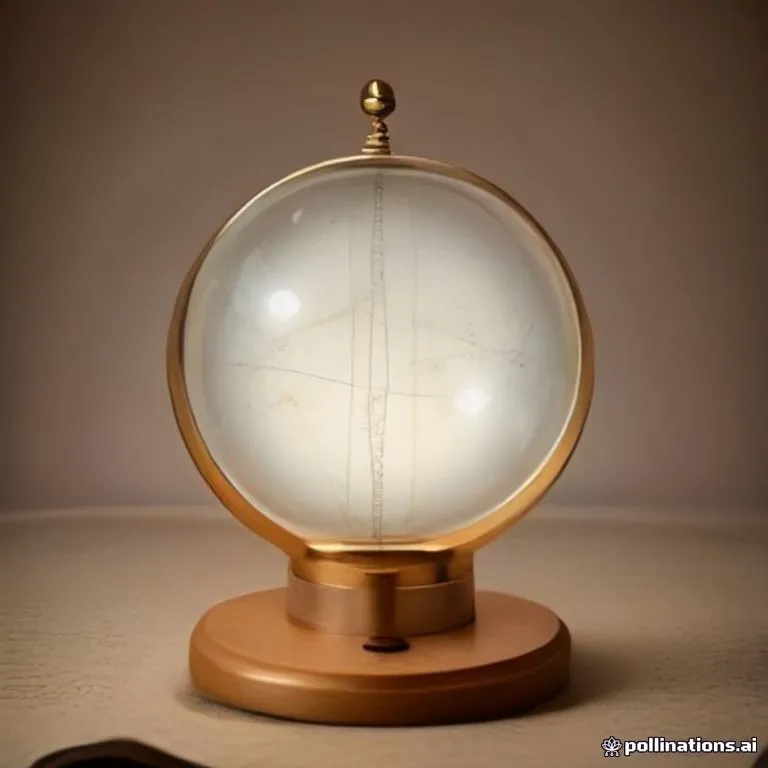
A Crookes radiometer (also known as a light mill) is a glass bulb containing a partial vacuum and a rotor with lightweight metallic vanes that rotate when exposed to radiant light energy.
Use / Function
- Measuring Radiation: Demonstrates and measures light intensity and electromagnetic radiation intensity.
- Physics Demonstration: Serves as an educational tool to illustrate thermal radiation, gas kinetics, and radiation pressure.
- Sensors: Inspires early designs for light-intensity measuring equipment and solar radiation detection.
- Scale: Small tabletop device.
Operating principle
The radiometer operates due to differential heating of the vane surfaces in a low-pressure gas environment.
- Vane Design: Four vanes mounted on a central spindle have one side painted black (absorbing light) and one side polished or painted white (reflecting light).
- Thermal Difference: When exposed to light, the dark sides absorb radiant heat and become warmer than the shiny sides.
- Gas Molecule Kinetics: Gas molecules inside the partial vacuum strike the warmer dark sides and bounce off with higher kinetic energy, producing a net thermal transpiration/rebound force that pushes the dark sides away and spins the rotor.
How to create it
- Vanes: Cut four small, lightweight square leaves of thin Metal (such as aluminum or mica with metal coating).
- Coating: Coat one surface of each vane with dark Paint or soot, leaving the opposite side shiny and reflective.
- Spindle Assembly: Mount the four vanes symmetrically around a central needle pivot made of Metal to minimize rotational friction.
- Enclosure: Enclose the rotor assembly inside a airtight bulb made of Glass.
- Evacuation: Evacuate air from the glass bulb using a vacuum pump until reaching a low partial pressure (roughly $10^{-2}$ torr).
- Sealing: Flame-seal the glass vacuum tube at the base to permanently maintain the partial vacuum.
Materials needed
- Enclosure: High-clarity Glass bulb.
- Rotor Vanes: Thin sheet Metal or lightweight metallic foil.
- Absorptive Coating: Matte black Paint or soot.
- Pivot: Hardened metal needle bearing.
Variants and improvements
- Nichols Radiometer: Measures true radiation pressure in a high vacuum using torsion balances rather than gas kinetic effects.
- Solar Insolation Sensors: Modern pyranometers and radiometers built for weather and solar energy stations.
Limits and risks
- Vacuum Sensitivity: If the vacuum is too high or too low, the rotation slows down or stops completely.
- Fragility: Thin glass enclosure can shatter if knocked or subjected to thermal shock.