Generated with AI3 min read
Arch
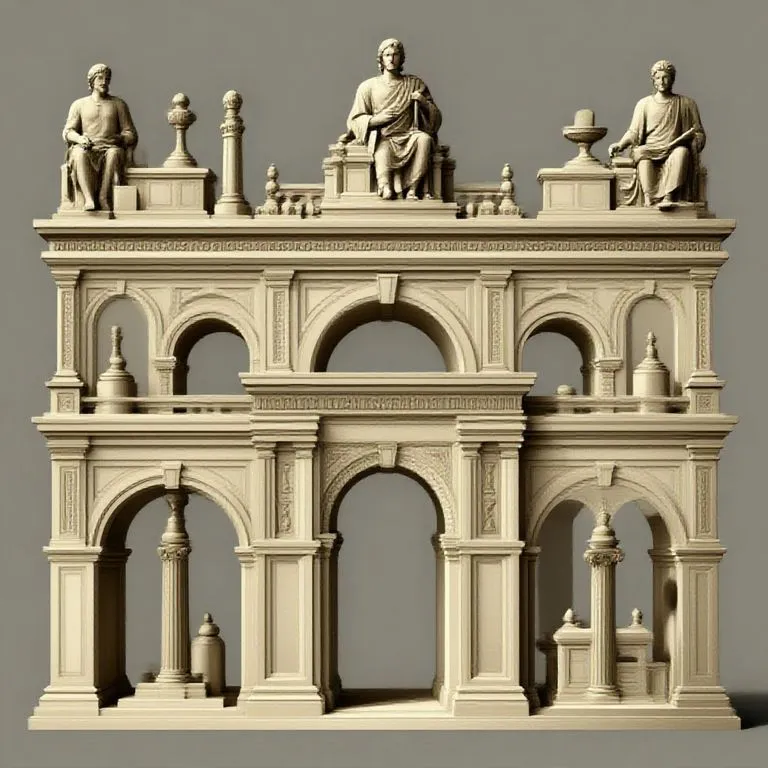
Brief description
A curved symmetrical structure spanning an opening and typically supporting the weight of a bridge, roof, or wall above it. It was a revolutionary invention that allowed for larger openings and stronger structures than simple beams.
Use / Function
- Structural Support: Spans openings for doors, windows, and Arch Bridges.
- Distribution: Distributes weight outwards and downwards to the pillars or abutments.
- Aesthetics: Provides a pleasing curved shape.
- Scale: From small doorways to massive aqueducts and domes.
Operating principle
The arch works by compression.
- Gravity pulls the weight of the arch and the load above it downwards.
- The wedge-shaped stones (voussoirs) push against each other.
- This force is transferred outwards along the curve to the supports (abutments).
- The Keystone at the top locks the entire structure in place.
Because stone and brick are strong in compression but weak in tension, the arch allows them to span large distances without breaking.
How to create it
- Supports: Build the side pillars or abutments.
- Centering: Construct a temporary wooden frame (centering) in the exact shape of the arch. This supports the stones during construction.
- Laying Stones: Place stones (voussoirs) on the centering, building up from both sides simultaneously.
- Keystone: Drop the central stone (keystone) into place at the top. This locks the arch.
- Removal: Carefully remove the wooden centering. The arch should now stand on its own.
Materials needed
- Essential:
- Stone/Brick: Shaped into wedges (voussoirs).
- Mortar: To bind the stones (though dry stone arches are possible).
- Wood: Critical for the temporary centering frame.
- Tools: Chisels (for shaping stone), saws (for wood), levels.
Variants and improvements
- Round Arch: The classic semi-circular arch (Roman).
- Pointed Arch: Stronger and taller (Gothic). Allows for less side thrust.
- Flat Arch: Looks like a beam but works like an arch.
- Vault: An arch extended in depth (like a tunnel).
- Dome: An arch rotated 360 degrees.
Limits and risks
- Lateral Thrust: The arch pushes outwards at the base. If the abutments aren’t heavy or buttressed enough, the walls will spread and the arch will collapse.
- Asymmetry: If the load is not balanced, the arch can fail.
- Construction Risk: Removing the centering is the most dangerous moment; if the mortar hasn’t set or the geometry is wrong, it collapses immediately.
- Limited Span: While strong, stone arches have a practical span limit. For longer distances, steel and cable structures like Cable-Stayed Bridges are preferred.