Generated with AI3 min read
Tesla Coil
Brief description
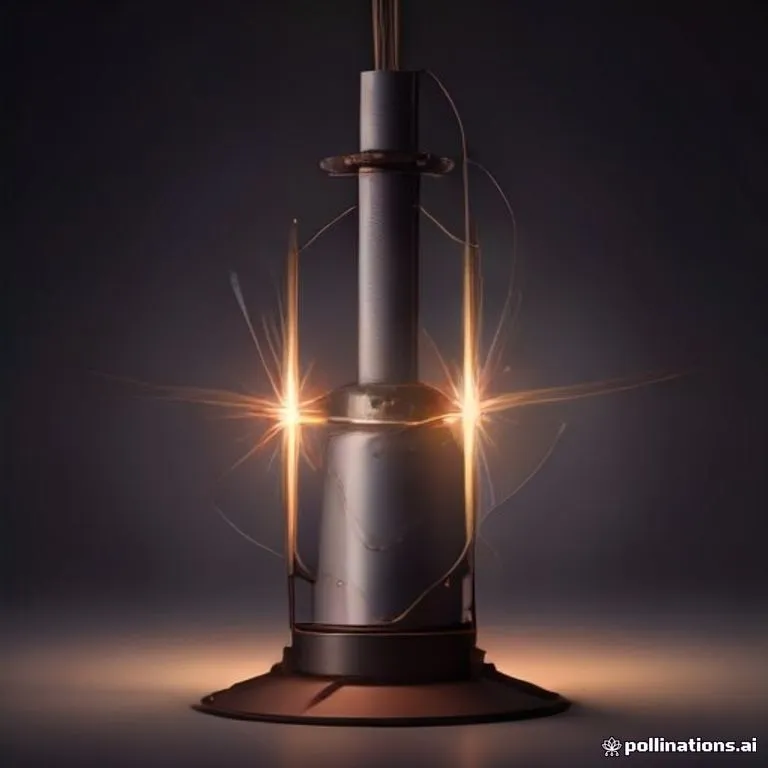
A Tesla coil is an electrical resonant transformer circuit used to produce high-voltage, low-current, high-frequency alternating-current electricity. Designed by Nikola Tesla, it demonstrates resonant inductive coupling and generates high-frequency electrical discharges across air gaps.
Use / Function
- Primary Use: Generating high-voltage, high-frequency radio frequency (RF) electrical discharges and wireless electrical transmission experiments.
- Secondary Uses: Early radio transmitters (spark-gap radio), spark gap accelerators, vacuum tube leak detection, and physics education.
- Scale: Small laboratory benchtop apparatus to large industrial and high-voltage testing installations.
Operating principle
- Energy Storage: High-voltage AC charges a primary capacitor through a step-up transformer.
- Spark Gap Discharge: When voltage across the spark gap reaches breakdown, a spark jumps, closing the primary circuit and causing high-frequency oscillations.
- Resonant Induction: Energy transfers inductively from the heavy primary coil (few turns) to the secondary coil (many turns).
- Resonance Tuning: Both primary and secondary tuned circuits oscillate at the exact same resonant frequency, amplifying secondary voltage to hundreds of thousands of volts.
- Top Terminal Discharge: Accumulated charge on the top capacitance sphere (toroid) breaks down surrounding air, creating brilliant electrical sparks.
How to create it
- Primary Circuit Assembly: Wire a high-voltage transformer to a spark gap and a high-voltage capacitor bank.
- Primary Coil Winding: Wind a heavy Copper tube or thick Wire into a wide, low-turn spiral (3–6 turns) around the base.
- Secondary Coil Winding: Tightly wind fine enamel-insulated copper Wire around a non-conductive form (such as Glass or plastic PVC pipe) for several hundred turns.
- Top Terminal Mount: Attach a smooth metallic sphere or toroid (e.g., aluminum ducting or metal sphere) to the top of the secondary winding to act as a terminal capacitor.
- Grounding: Connect the bottom of the secondary coil to a solid earth ground.
- Tuning: Adjust the primary tap point to match the resonant frequency of the secondary circuit.
Materials needed
- Coil Conductors: Heavy enamel-coated copper Wire and thick copper tubing.
- Insulation & Form: Glass or non-conductive plastic tubing.
- Capacitors: High-voltage dielectric capacitor bank (glass/polyethylene plates or ceramic caps).
- Power Supply: High-voltage step-up transformer (e.g., neon sign transformer or ignition coil).
- Spark Gap: Adjustable copper electrodes mounted on heat-resistant insulating material.
Variants and improvements
- Spark Gap Tesla Coil (SGTC): Traditional design using an air spark gap switch.
- Solid State Tesla Coil (SSTC): Uses power transistors (IGBTs or MOSFETs) instead of a spark gap for precise frequency drive.
- Dual Resonant Solid State Tesla Coil (DRSSTC): Combines solid-state switching with resonant tuning for long, controllable sparks.
Limits and risks
- Electrocution Hazard: High-voltage primary circuits are lethal; extreme caution is required around primary power supplies.
- Radio Frequency Interference: Emits powerful electromagnetic interference (EMI) across broadcast bands if unshielded.
- Ozone & UV Generation: Electrical discharges produce ozone, nitrogen oxides, and ultraviolet radiation; operate in well-ventilated spaces with UV eye protection.