Generated with AI3 min read
Stirling Engine
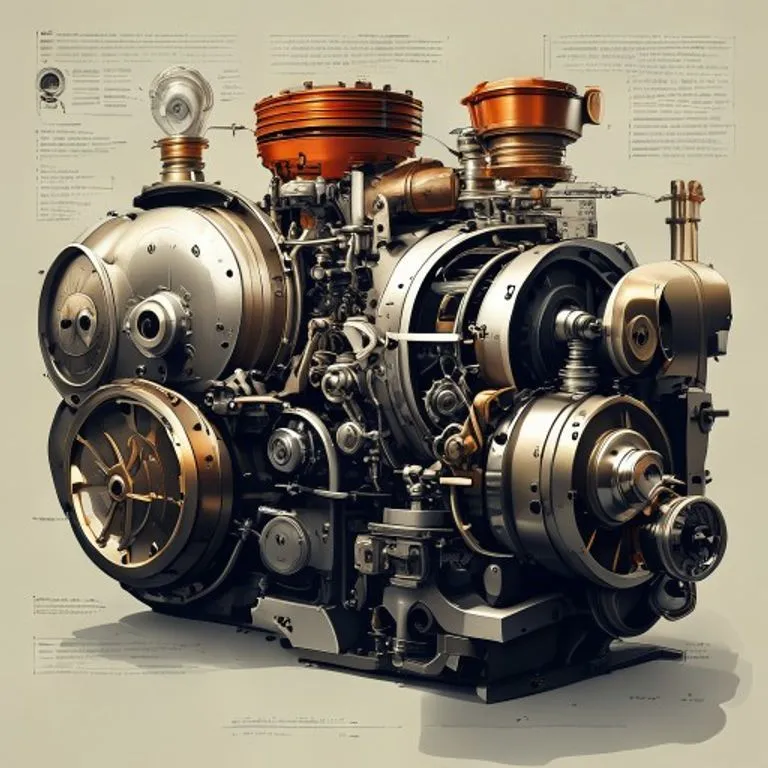
Brief description
A Stirling engine is a closed-cycle regenerative heat engine that operates by cyclic compression and expansion of air or another gas (the working fluid) at different temperature levels, converting thermal energy into mechanical work. Unlike internal combustion engines, heat is supplied from an external source without burning fuel inside the cylinder.
Use / Function
- Mechanical Power Generation: Drives water pumps, fans, small machinery, or generators using any external heat source (solar, biomass, waste heat).
- Silent & Low-Maintenance Power: Useful in quiet environments or remote locations requiring high reliability and low maintenance.
- Scale: Ranges from small educational tabletop models to moderate industrial solar concentrators or auxiliary power generators.
Operating principle
- Heating: A fixed quantity of gas inside a sealed cylinder is heated by an external source at the hot end, causing the gas to expand.
- Expansion & Work: The expanding gas pushes a power Piston, doing mechanical work on a crankshaft.
- Displacement: A displacer piston moves the warm gas to the cold side of the cylinder.
- Cooling & Compression: The gas cools at the cold end, contracting in volume. The power piston compresses the cold gas back with minimal work input.
- Regeneration: The displacer moves the gas back to the hot side through a regenerator (Heat Exchanger), recycling stored heat to repeat the cycle.
How to create it
- Construct the Hot & Cold Cylinders: Fabricate a high-temperature resistant hot cylinder (from Steel or Iron) and a well-cooled cold cylinder (from Brass or Copper with cooling fins).
- Fabricate the Displacer: Build a lightweight, heat-resistant displacer piston with a loose fit inside the hot cylinder to allow gas to pass around or through it.
- Build the Power Piston: Machine a precise, airtight power piston and cylinder pair with minimal friction and no air leakage.
- Link the Crankshaft: Connect both the displacer and power piston to a common crankshaft with a 90-degree phase difference to coordinate gas movement and work extraction.
- Attach a Flywheel: Mount a heavy Flywheel to smooth out rotational energy and carry the mechanism through compression phases.
Materials needed
- Hot Section: Stainless Steel or Iron (heat resistant).
- Cold Section & Radiator: Copper or Brass (high thermal conductivity).
- Pistons & Seals: Machined bronze, graphite, or Steel.
- Flywheel & Frame: Cast Iron, Steel, or hard Wood.
- Heat Source: Concentrated solar energy, burning Wood, Charcoal, or waste heat.
Variants and improvements
- Alpha Configuration: Uses two separate power pistons in different temperature cylinders connected by a pipe containing a regenerator.
- Beta Configuration: Uses a single cylinder housing both the displacer and power piston on the same axis.
- Gamma Configuration: Uses separate cylinders for the displacer and power piston, linked externally to the same crankshaft.
- Solar Stirling Concentrator: Uses parabolic mirrors to focus solar thermal rays directly onto the engine hot head for high-efficiency solar power generation.
Limits and risks
- Power-to-Weight Ratio: Generally heavier and bulkier for a given power output compared to internal combustion engines.
- Thermal Inertia: Cannot change speed or power output rapidly; slow start-up and acceleration response.
- Sealing & Leakage: Gas leaks reduce efficiency drastically over long periods.
- High Heat Strain: The hot cylinder end is subjected to continuous thermal stress and oxidation.