Generated with AI3 min read
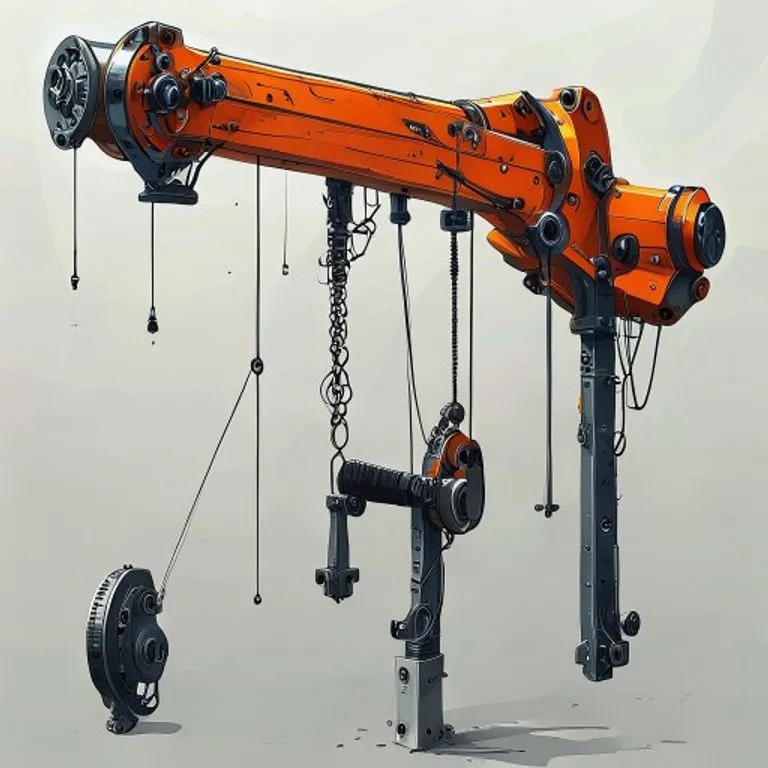
Jib (Lifting Arm)
Made of
Brief description
A projecting arm or beam used on cranes and derricks to support the load clear of the main support structure. It extends the reach of the lifting mechanism.
Use / Function
- Reach: Allows lifting loads at a distance from the mast or base.
- Horizontal Movement: In rotating cranes, the jib sweeps a circle to move loads horizontally.
- Radius Adjustment: By raising or lowering the jib (luffing), the lifting radius can be changed.
Operating principle
- Leverage: The jib acts as a cantilever or supported beam. The load exerts a downward force at the tip, which is countered by the support cable (tension) and the hinge/mast (compression).
- Triangulation: The mast, jib, and tie-cable typically form a triangle, distributing the load forces efficiently through the structure.
How to create it
- Spar Selection: Select a straight, strong pole (wood) or construct a truss framework (metal). The length determines the reach.
- Hinge Assembly: Create a pivot point at the base of the jib to attach it to the mast. This allows vertical movement (luffing).
- Sheave Installation: Mount a pulley (sheave) at the tip of the jib for the hoist rope to run through.
- Support Cabling: Attach a strong cable (tie or luffing cable) from the tip of the jib to the top of the mast to support the weight of the jib and the load.
Materials needed
- Structural: Strong wood (oak, pine) for simple spars, or iron/steel trusses for heavy-duty jibs.
- Fittings: Metal brackets or heavy rope lashings for the hinge and pulley mount.
- Cabling: Rope or steel cable for the support line.
Variants and improvements
- Fixed Jib: The angle is fixed relative to the mast; only the hook moves up and down. Simpler to build but less flexible.
- Luffing Jib: The angle can be changed during operation to move the load closer to or further from the base.
- Telescopic Jib: Composed of multiple nested sections that slide inside each other to extend the total length hydraulically or mechanically.
- Gooseneck Jib: An angled section at the tip to provide clearance for bulky loads.
Limits and risks
- Overloading: Exceeding the rated capacity can snap the jib or cause the entire crane to tip over.
- Side-loading: Pulling loads sideways (instead of vertically) puts twisting forces on the jib that can cause it to buckle and collapse.
- Fatigue: Repeated stress cycles can cause microscopic cracks in metal jibs, leading to sudden failure.
- Clearance: A long jib requires significant clearance to rotate without hitting obstacles.