Generated with AI4 min read
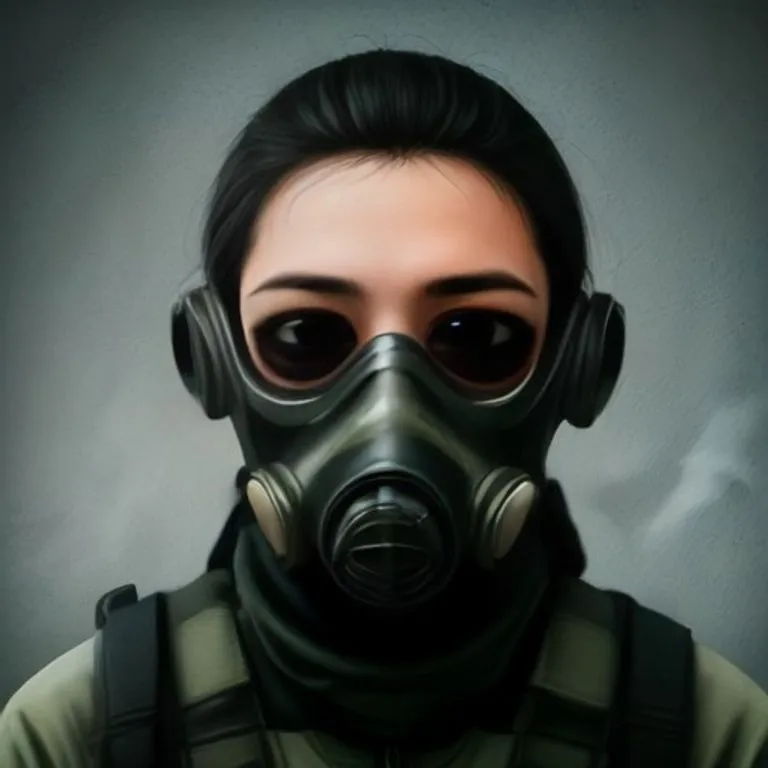
Gas Mask
Brief description
A gas mask (or air-purifying respirator) is a protective device worn over the face to protect the wearer from inhaling airborne pollutants, toxic gases, industrial fumes, chemical agents, and particulate hazards such as smoke, silica dust, or radioactive fallout. It filters ambient air before it reaches the respiratory system.
Use / Function
Its primary purpose is individual respiratory protection in hazardous airborne environments:
- Hazardous Atmospheres: Provides breathable air in environments contaminated by smoke, toxic chemicals, industrial gases (such as chlorine, ammonia, or sulfur dioxide), or biological spores.
- Fallout & Dust Protection: Filters out fine particulate matter, including radioactive fallout particles and volcanic ash.
- Scale: Domestic, tactical, agricultural, and industrial applications.
Operating principle
A gas mask relies on two complementary filtration mechanisms operating in sequence:
- Particulate Mechanical Filtration: Fibrous material (such as dense felt or multi-layer woven cotton) mechanically traps suspended solid particles and liquid droplets through inertial impaction, interception, and diffusion.
- Adsorption of Chemical Gases: Contaminated air passes through a chamber packed with activated Charcoal. Activated charcoal possesses an exceptionally porous micro-structure with a massive internal surface area ($500\text{–}1500,\text{m}^2/\text{g}$). Non-polar chemical vapours and organic gases adhere to the carbon surface through van der Waals forces (adsorption).
- One-Way Gas Flow: Check valves control the airflow direction. An inhalation valve allows air to enter through the filter canister into the facepiece, while an exhalation valve vents moisture-laden exhaled air directly outside without bypassing the filter or degrading the charcoal.
How to create it
To construct an improvised air-purifying respirator canister and tight-sealing mask:
- Prepare Activated Charcoal: Pyrolyze hardwood or coconut shells into charcoal. Crush it into uniform granules (1–3 mm). Activate the charcoal by soaking it in a 25% solution of calcium chloride or sodium carbonate, rinsing with clean water, and heating to high temperature ($600\text{–}800^\circ\text{C}$) in an oxygen-deprived container to expand its pore matrix.
- Build the Filter Canister: Take a cylindrical metal or sturdy rigid plastic container. Drill small air inlet holes in the bottom cap. Line the inner bottom with a dense layer of cotton Fabric or felt as a particulate pre-filter.
- Pack the Filter Bed: Fill the cylinder with a 5–8 cm layer of activated charcoal granules, packing them tightly to prevent channeling (air forming bypass pathways). Add an upper layer of dense felt or wool to hold the carbon bed in place and capture fine carbon dust.
- Construct the Face Mask: Shape a flexible rubber hood using Natural Rubber or sealed leather that fits tightly around the contours of the mouth, nose, and chin. Cut two eye openings and seal clear Glass discs over them using waterproof adhesive.
- Install One-Way Valves: Install thin rubber flap valves at the intake joint (connecting to the canister tube) and at the exhalation port at the bottom of the mask.
- Seal and Test: Secure adjustable elastic straps around the head. Test the facial seal by blocking the air intake with your hand and inhaling; if the mask collapses inward against your face without leaking ambient air around the edges, the seal is airtight.
Technical Level: Intermediate. Requires proper activation of charcoal and meticulous airtight fitting around the face.
Materials needed
- Filter Canister:
- Facepiece Assembly:
- Flexible Natural Rubber sheet or soft leather for the mask skirt.
- Transparent Glass or clear plastic for eye lenses.
- Elastic head straps.
- One-way rubber flap valves.
Variants and improvements
- Improvised Wet Filters: Early wartime respirators used cotton pads saturated with chemical neutralizing solutions (such as sodium thiosulfate or dilute caustic soda) to neutralize specific acidic gases like chlorine.
- Chemical Chemisorption: Impregnating activated charcoal with metallic salts (copper, silver, chromium) enables chemical reaction with non-adsorbing toxic gases like hydrogen cyanide or phosgene.
- Powered Air-Purifying Respirator (PAPR): Incorporates a battery-powered blower fan to force air through the filter, reducing breathing resistance and increasing comfort during long exposures.
Limits and risks
- Oxygen Deficiency: A gas mask only filters air; it does NOT produce oxygen. It cannot be used in oxygen-deficient environments ($< 19.5%\ \text{O}_2$), such as confined tanks or fire-engulfed rooms.
- Filter Saturation: Activated charcoal has a finite adsorption capacity. Once the carbon surface pores become saturated, toxic fumes will break through without warning (“breakthrough”). Filters must be replaced or re-activated periodically.
- Carbon Monoxide Warning: Standard activated charcoal does NOT filter carbon monoxide ($CO$). Specialty catalysts (like Hopcalite) are required to oxidize carbon monoxide to carbon dioxide.