Generated with AI2 min read
Drawing Compass
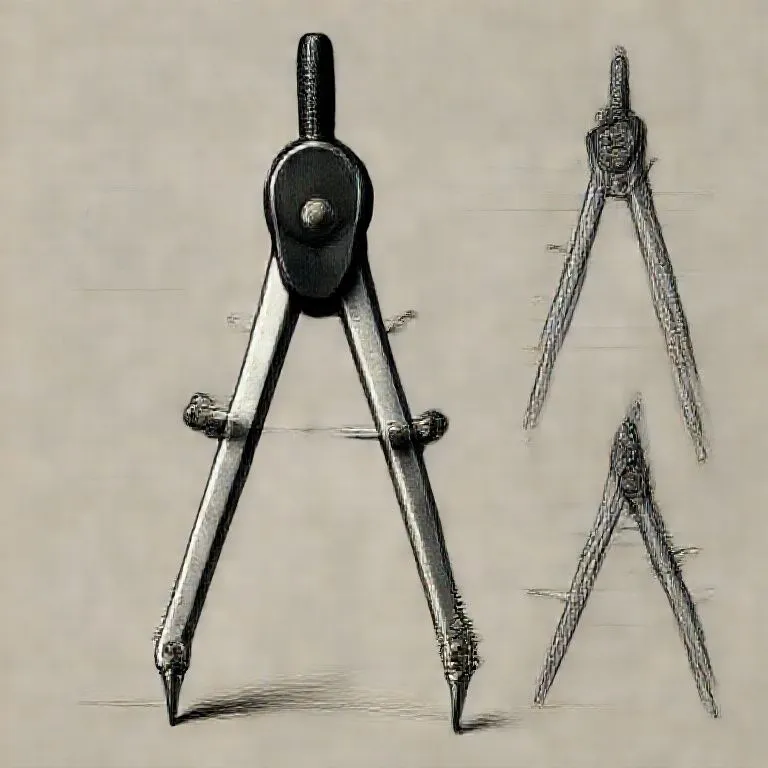
Brief description
A technical drawing instrument that can be used for inscribing circles or arcs. As dividers, they are also used as a tool to measure distances, in particular on maps. It consists of two parts (legs) connected by a hinge which can be adjusted to change the radius of the circle drawn or the distance measured.
Use / Function
- Geometry: Drawing perfect circles and arcs.
- Navigation: Measuring distances on maps (using dividers).
- Carpentry: Marking measurements and scribing (transferring profiles).
- Masonry: Laying out stone patterns.
Operating principle
The compass works on the principle of a fixed radius. By fixing one leg (the needle point) and rotating the other leg (the drawing point) around it, a circle is created. The distance between the two legs determines the radius. Friction at the hinge keeps the legs at a constant angle.
How to create it
- Legs: Shape two straight legs from wood, bone, or metal. They should be sturdy and straight.
- Hinge: Connect the two legs at the top.
- Simple: Tie them together tightly with cord/leather (lash compass).
- Better: Use a rivet or a screw that allows movement but provides enough friction to hold the position.
- Points:
- Anchor Point: Sharpen one leg to a point or attach a metal needle.
- Drawing Point: The other leg can also be sharp (for scratching/scribing) or have a holder for charcoal, lead, or ink.
Materials needed
- Legs: Hardwood, Bone, Brass, Iron, or Steel.
- Hinge: Leather thong, rivet, or screw.
- Tips: Hardened steel or iron for the points; charcoal or lead for drawing.
Variants and improvements
- Dividers: Both legs have sharp points. Used solely for measuring and transferring distances.
- Beam Compass: Two points slide along a beam (rod) to draw very large circles.
- Spring Compass: A spring bow holds the legs apart, and a screw adjusts the distance, offering greater precision.
- Calipers: Curved legs for measuring outside or inside diameters of objects.
Limits and risks
- Slip: The anchor point can slip if not pressed firmly, ruining the drawing.
- Accuracy: A loose hinge leads to inaccurate circles.
- Size: Limited by the length of the legs (unless using a beam compass).