Generated with AI2 min read
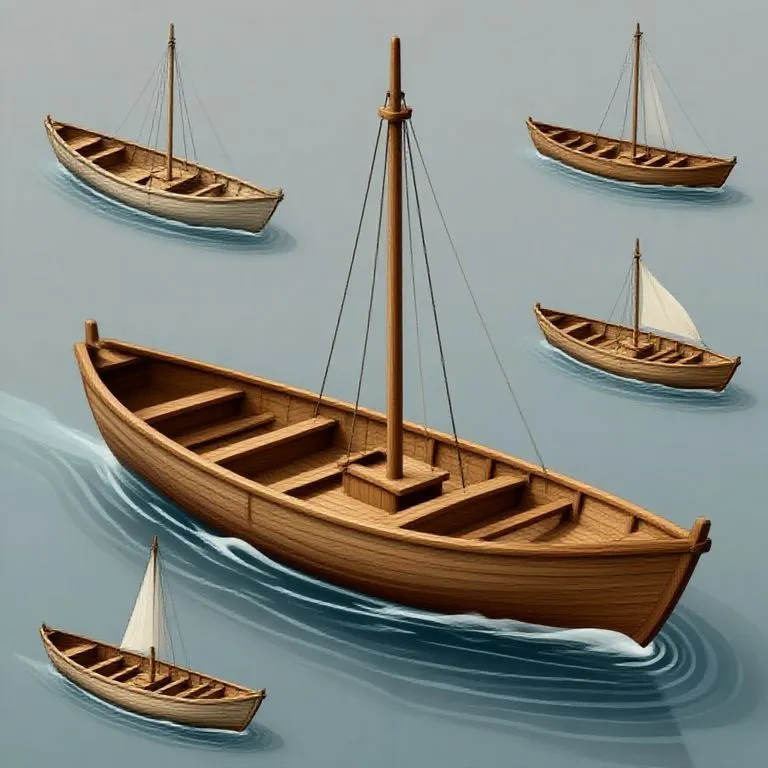
Simple Boat
Made of
Brief description
A simple boat is a watercraft constructed from wooden planks or boards, joined together to form a hull. Unlike a raft (which relies on material buoyancy) or a dugout canoe (carved from a single log), a simple boat relies on water displacement by a watertight hollow hull for buoyancy.
Use / Function
- Transportation: Carrying passengers and cargo over longer distances than canoes.
- Fishing: Enabling fishing in deeper waters or further from shore.
- Trade: Facilitating commerce between coastal or river communities.
Operating principle
Displacement: The boat is designed to displace a volume of water that weighs more than the boat and its cargo. The upward buoyant force equals the weight of the water displaced. Hydrodynamics: The hull is shaped to cut through water with minimal resistance (drag) while maintaining stability.
How to create it
- Keel Laying: Lay down a strong central beam (keel) which serves as the spine of the boat.
- Framing: Attach curved ribs or frames to the keel to define the shape of the hull.
- Planking: Attach wooden planks to the frames (carvel) or overlapping each other (clinker) to form the outer shell.
- Caulking: Fill the gaps between planks with fibrous material (like hemp or oakum) soaked in pitch or resin to make the hull watertight.
- Outfitting: Add seats (thwarts), oarlocks for [[oar|Oars]], or a mast for a [[sail|Sail]].
Materials needed
- Wood: Planks for the hull (cedar, oak, pine) and strong timber for the keel/frames.
- Fasteners: Wooden pegs (treenails), copper/iron nails, or strong rope lashing.
- Sealant: Pitch, tar, or resin mixed with fibers for caulking.
- Tools: Saws, axes, augers, hammers, adzes.
Variants and improvements
- Rowboat: Propelled primarily by oars.
- Sailboat: Fitted with a mast and sail for wind propulsion.
- Dory: A flat-bottomed boat with high sides, good for launching from beaches.
Limits and risks
- Leakage: Requires constant maintenance to keep caulking intact; a leak can sink the boat.
- Capsizing: Can tip over in rough seas if not properly handled or ballasted.
- Rot: Wood will rot if not treated or kept dry when not in use.