Generated with AI3 min read
Perpetual Motion
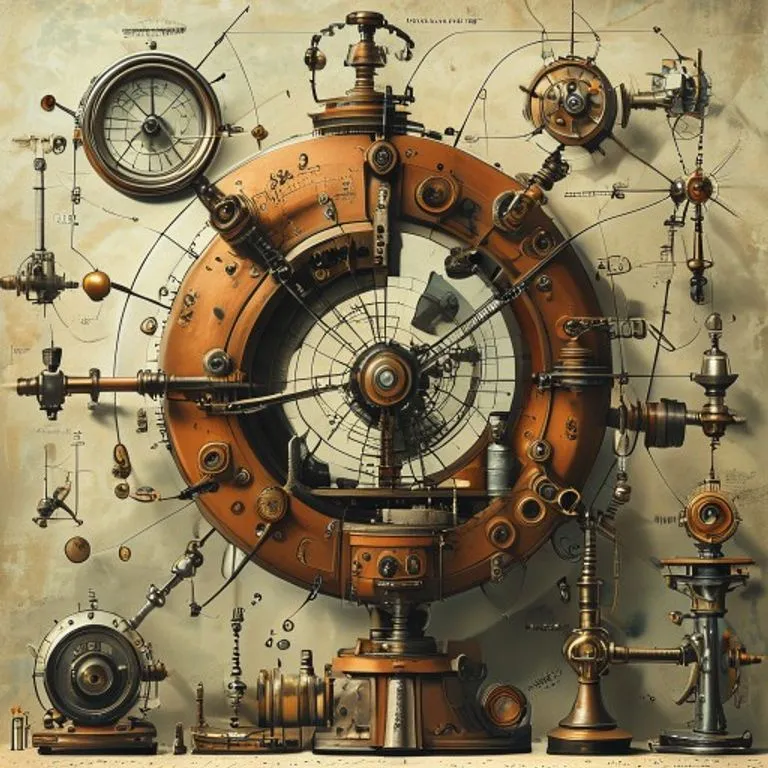
Brief description
A perpetual motion machine is a hypothetical device that can do work indefinitely without an external energy source. While impossible according to the laws of physics, the pursuit of such a machine has driven mechanical innovation for centuries.
Use / Function
- Theoretical Goal: To generate unlimited free energy.
- Historical Impact: Led to a deeper understanding of mechanics, friction, and thermodynamics.
- Educational Tool: Analyzing why these machines fail is an excellent way to learn physics.
Operating principle
These machines attempt to violate the laws of thermodynamics:
- First Kind: Machines that produce more energy than they consume (violates conservation of energy).
- Second Kind: Machines that spontaneously convert thermal energy into mechanical work without a temperature difference (violates entropy).
Most designs rely on gravity, buoyancy, or magnetism to create an unbalanced force that supposedly keeps the machine moving.
How to create it (Historical Attempts)
Note: These designs do not work forever, but they are famous attempts.
The Overbalanced Wheel (Bhaskara’s Wheel)
- Wheel: A large wheel mounted on an axle.
- Arms: Hinged arms or curved tubes attached to the rim.
- Weights: Heavy weights (or mercury) that swing out on one side and fold in on the other.
- Concept: The weights on the descending side are further from the center, creating more torque than the ascending side.
- Reality: The number of weights on the ascending side is greater, balancing the torque exactly.
The Magnetic Motor
- Rotor: A wheel with magnets angled in one direction.
- Stator: Fixed magnets arranged to repel the rotor magnets.
- Concept: The magnetic repulsion pushes the wheel constantly.
- Reality: The energy gained entering a magnetic field is lost leaving it.
Materials needed
- Precision Components: Ball and Roller Bearings to minimize friction (the main enemy).
- Weights: Lead, Mercury, or Iron.
- Magnets: Magnetite or strong artificial Magnets.
Variants and improvements
- Capillary Bowl: Uses capillary action to lift fluid, hoping it drops back down to drive a wheel (Boyle’s Flask).
- Float Belt: Buoyant objects rising in water and falling in air.
- Cox’s Timepiece: A clock powered by changes in atmospheric pressure (technically not perpetual motion, as it draws energy from the environment, but runs “indefinitely”).
Limits and risks
- Thermodynamics: The First and Second Laws of Thermodynamics make true perpetual motion impossible.
- Friction: All moving parts experience friction, which dissipates energy as heat. The machine eventually stops.
- Fraud: Many “working” examples throughout history were hoaxes powered by hidden springs or people.
- Resource Waste: Endless time and materials can be wasted chasing this impossibility.