Generated with AI3 min read
Scythe
Brief description
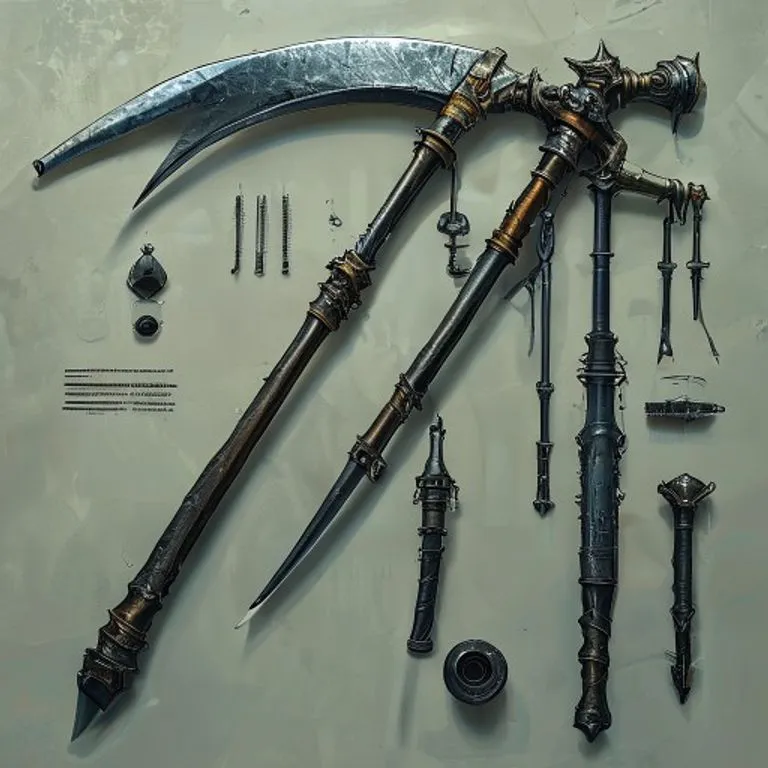
A scythe is a large, two-handed agricultural tool with a long, curved blade mounted on a long handle called a snath. It is used for mowing grass or reaping crops, allowing the user to work while standing upright.
Use / Function
- Mowing: Cutting large areas of grass for hay or fodder.
- Reaping: Harvesting cereals like wheat, barley, and rye.
- Vegetation Management: Clearing weeds and tall brush more efficiently than with a sickle.
Operating principle
The scythe uses the momentum of a wide, horizontal swing to slice through vegetation.
- Ergonomics: The long handle (snath) and its two grips (nibs) allow the user to stand straight, reducing back strain.
- Slicing Action: The blade is curved so that it slices through the stalks rather than hitting them directly, which requires less force and keeps the blade sharp longer.
- Rhythm: Efficient scything depends on a steady, rhythmic motion of the whole body.
How to create it
Traditional Scythe
- Blade: A long, thin, curved blade forged from high-quality Steel. The blade is often “tensioned” by hammering (peening) to make it thin and hard.
- Snath: A long wooden pole, often curved to improve the angle of the blade to the ground.
- Nibs: Two handles attached to the snath, adjustable to the user’s height and arm length.
- Ring/Fittings: An iron ring and wedge or screw system to securely attach the blade (tang) to the end of the snath.
Materials needed
- Blade: Steel (must be able to hold a very fine edge).
- Snath and Nibs: Wood (Ash or Willow are traditional for their strength and lightness).
- Fittings: Iron or steel.
- Maintenance: Peening hammer and anvil, and a whetstone for honing the edge in the field.
Variants and improvements
- Grass Scythe: Has a long, thin blade for cutting soft grass.
- Brush Scythe: Has a shorter, heavier blade for cutting tough weeds and woody stalks.
- Cradle Scythe: Features a wooden frame (cradle) attached to the blade to catch the grain and lay it neatly in rows (windrows) for easier gathering.
Limits and risks
- Skill Requirement: Requires significant practice to master the swing and the maintenance (peening) of the blade.
- Sharpness: The blade must be kept extremely sharp to be effective, posing a constant risk of injury.
- Topography: Difficult to use on very rocky or extremely uneven ground.
Related Inventions
- Sickle (Smaller, one-handed predecessor)
- Reaper (Mechanical version)
- Grinding Wheel