Generated with AI3 min read
Rain Gauge
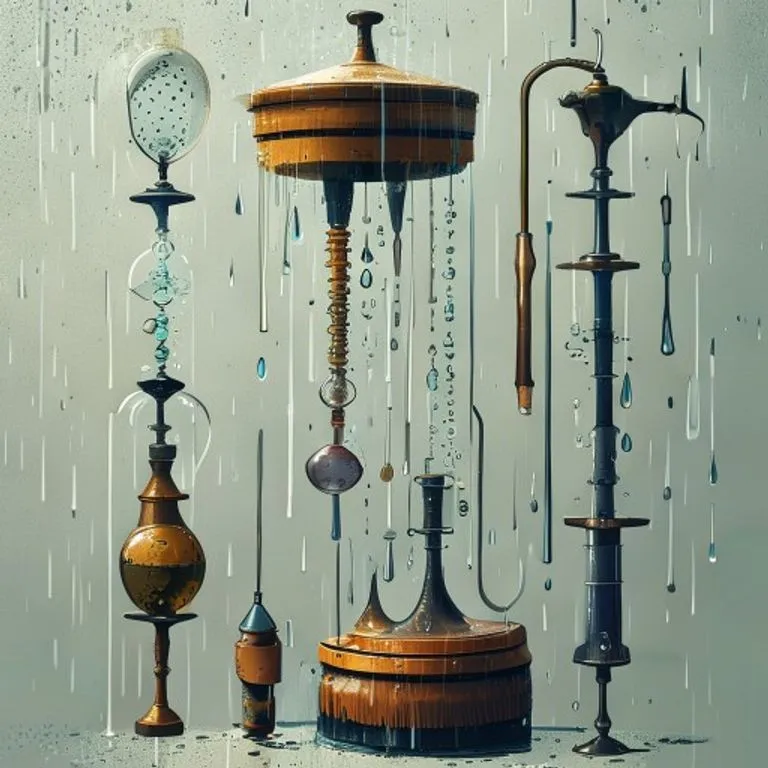
Brief description
A rain gauge is an instrument used by meteorologists and hydrologists to gather and measure the amount of liquid precipitation over a set period of time.
Use / Function
- Primary use: Measuring rainfall in millimeters or inches.
- Secondary uses: Agricultural planning, flood risk assessment, and long-term climate monitoring.
- Scale: Local (gardens, farms) to Regional (weather stations).
Operating principle
The simplest rain gauge consists of a collection container with a funnel to gather water from a larger area into a smaller measuring tube.
- Area Concentration: The top of the funnel has a known area. The water is funneled into a narrow cylinder.
- Magnification: Because the measuring cylinder is narrower than the funnel opening, the depth of the water is “magnified”, allowing for more precise readings of small rainfall amounts.
- Measurement: The depth of the collected water is measured and then calculated as the height of rain that would have fallen on a flat surface.
How to create it
Standard Rain Gauge
- Level: Basic.
- Collector: A large funnel or wide-mouthed container.
- Measuring Tube: A narrow, transparent cylinder (glass or plastic) with a flat bottom.
- Mounting: Place the funnel at the top of the tube. Ensure the assembly is mounted vertically and perfectly level.
- Calibration: Create a scale on the tube. If the funnel area is 10 times the tube area, 10 mm of water in the tube equals 1 mm of actual rainfall.
Materials needed
- Essential: A funnel, a transparent and narrow collection vessel, and a stable support.
- Tools: Measuring tape and marking tools for the scale.
- Substitutes: Any straight-sided cylinder can work as a primitive rain gauge (the depth of water is directly the rainfall amount), but it is less precise for light rain.
Variants and improvements
- Tipping Bucket Rain Gauge: A funnel leads water to a pair of small “buckets” on a pivot. When one fills, it tips, sending an electrical pulse and bringing the other bucket into place.
- Weighing Rain Gauge: Measures the weight of the collected water to determine the amount (can also measure snow).
Limits and risks
- Evaporation: In hot climates, water can evaporate from the gauge before it is read. Funnels with narrow necks help reduce this.
- Wind: Strong winds can blow rain past the top of the gauge, leading to an under-collection.
- Obstacles: Must be placed in an open area, away from trees and buildings that could block rain or cause “splash-in” (extra water dripping from branches).
- Freezing: Collected water can freeze and crack glass vessels.