Generated with AI3 min read
Universal Joint
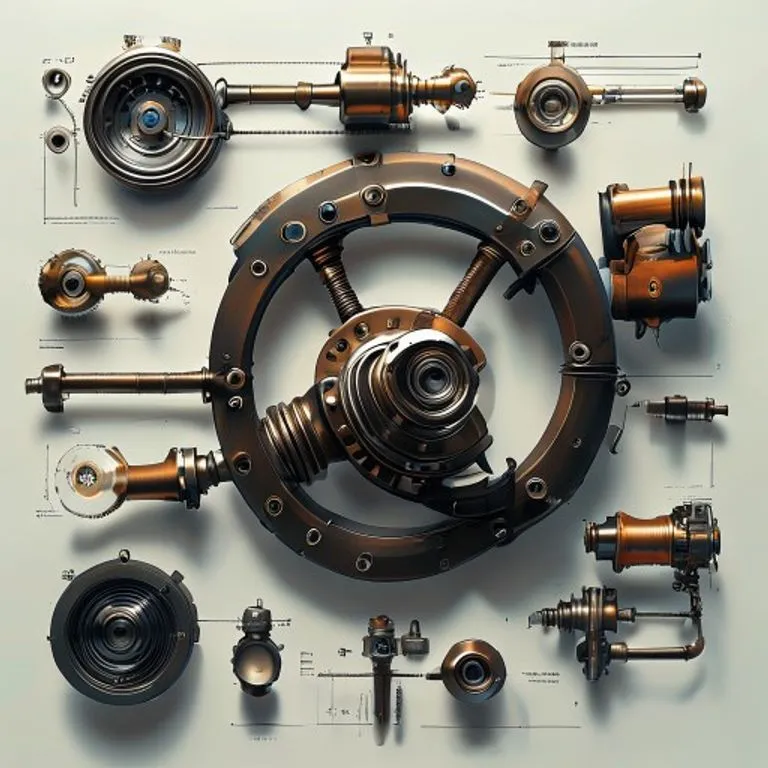
Made of
Brief description
A universal joint (also called a Cardan joint or U-joint) is a joint or coupling connecting rigid rods whose axes are inclined to each other. It allows for the transmission of rotary motion through an angle. It is commonly used in shafts that transmit rotary motion.
Use / Function
- Automotive: Used in drive shafts to transmit power from the transmission to the differential, accommodating the vertical movement of the wheels.
- Machinery: Connects motors to driven components when they cannot be perfectly aligned.
- Instrumentation: Used in control linkages and steering columns.
- Scale: From small mechanical instruments to large industrial drive shafts.
Operating principle
The universal joint consists of a pair of hinges located close together, oriented at 90° to each other, connected by a cross shaft.
- The input yoke is attached to the first shaft.
- The output yoke is attached to the second shaft.
- A cross-shaped component (the spider) connects the two yokes.
- As the input shaft rotates, the yokes and the spider pivot to allow the rotation to follow the angle of the second shaft.
- Note: A single universal joint does not transmit motion at a constant velocity if the angle is not zero; the output shaft speeds up and slows down twice per revolution.
How to create it
- Yoke Fabrication: Create two U-shaped yokes with holes for the cross-shaft bearings.
- Cross (Spider) Creation: Forge or machine a cross-shaped piece with four precision-ground journals.
- Bearing Assembly: Insert the journals of the cross into the holes of the yokes, typically using needle bearings or simple bushings for primitive versions.
- Securing: Use snap rings or plates to keep the assembly together while allowing free rotation on two axes.
- Technical Level: Intermediate to Advanced. Requires precise alignment and strong materials.
Materials needed
- Yokes and Cross: Forged Steel or high-strength Alloy Steel.
- Bearings: Hardened Steel (needle bearings) or Bronze (bushings).
- Lubricant: Grease (Animal fat for primitive versions).
- Tools: Forge, Lathe, Drill press, and Grinder.
Variants and improvements
- Double Cardan Joint: Uses two U-joints in series to cancel out the velocity fluctuations, creating a Constant Velocity (CV) effect.
- Constant Velocity (CV) Joint: A more complex joint (like the Rzeppa joint) that transmits motion at a perfectly constant speed regardless of the angle.
- Flexible Coupling: Uses rubber or fabric for small angles and vibration damping.
Limits and risks
- Vibration: At high speeds and steep angles, the non-constant velocity causes significant vibration and stress.
- Angle Limits: Usually limited to angles less than 30-45 degrees; efficiency drops and wear increases as the angle grows.
- Lubrication Failure: The needle bearings are subject to high loads; lack of grease leads to rapid wear and joint failure (clunking sounds or snapping).
- Catastrophic Failure: If a drive shaft U-joint snaps at high speed, it can cause the shaft to whip around, causing extensive damage.