Generated with AI2 min read
Pickaxe
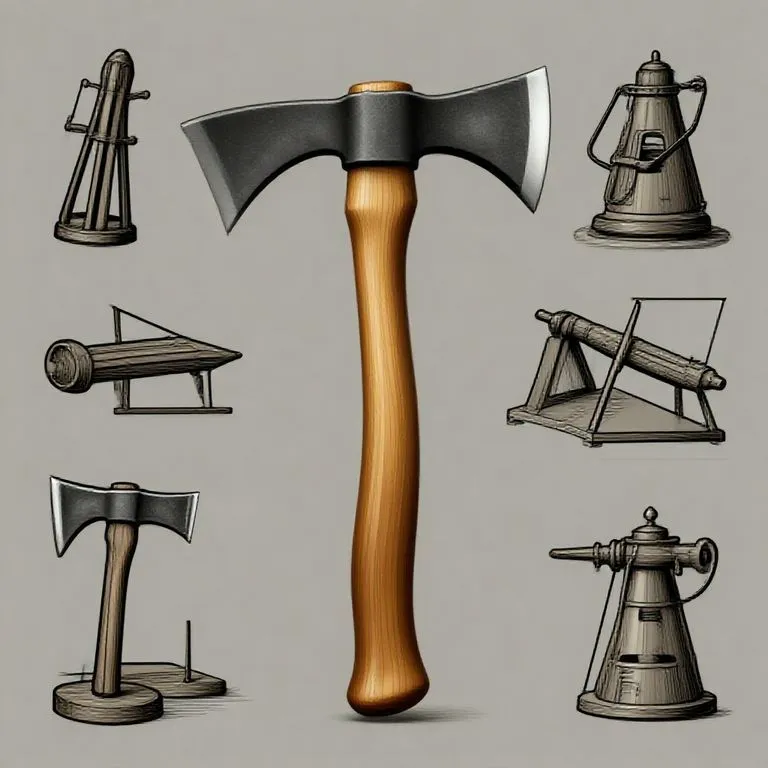
Brief description
A T-shaped hand tool used for prying, digging, and breaking hard surfaces. It typically has a head with a pointed end and a flattened end (chisel) mounted perpendicularly to the handle.
Use / Function
- Primary use: Breaking up hard soil, rock, and concrete.
- Secondary uses: Mining, prying out roots/stumps, agriculture (mattock), weapon.
- Scale: Individual.
Operating principle
- Concentrated Force: The pointed tip concentrates the swing’s energy into a tiny area, shattering hard materials.
- Leverage: The curve of the head and the long handle allow the user to pry apart rocks or soil.
- Momentum: The heavy head at the end of a swing builds significant kinetic energy.
How to create it
- Head Creation:
- Primitive: Use a deer antler (tine serves as pick) or a sharpened hard stone lashed to a handle.
- Metal: Forge a bar of iron/steel. Point one end and flatten the other. Punch an eye in the center for the handle.
- Hardening: Quench and temper the tips to prevent them from curling or dulling.
- Handle: Shape a strong, straight piece of hardwood (hickory, ash, oak).
- Assembly: Slide the handle through the eye. The eye is often tapered so the head slides down from the top and gets stuck (slip-fit), meaning centrifugal force tightens it.
Materials needed
- Essential:
- Head: Iron/Steel (best), Bronze, or Antler/Stone (primitive).
- Handle: Durable hardwood.
- Tools:
- Forge/Anvil: For metal heads.
- Grindstone: For sharpening.
- Knife/Rasp: For shaping the handle.
Variants and improvements
- Mattock: Has a broad adze blade instead of a point, used for cutting roots and digging in soft soil.
- Ice Axe: Specialized for climbing ice.
- Miner’s Pick: Often shorter for tight spaces.
Limits and risks
- Safety: The sharp points are dangerous to the user and others nearby. Watch your backswing.
- Fatigue: Heavy to use; requires good technique to let gravity do the work.
- Eye Protection: Breaking rocks sends flying chips; eyes are at risk.